
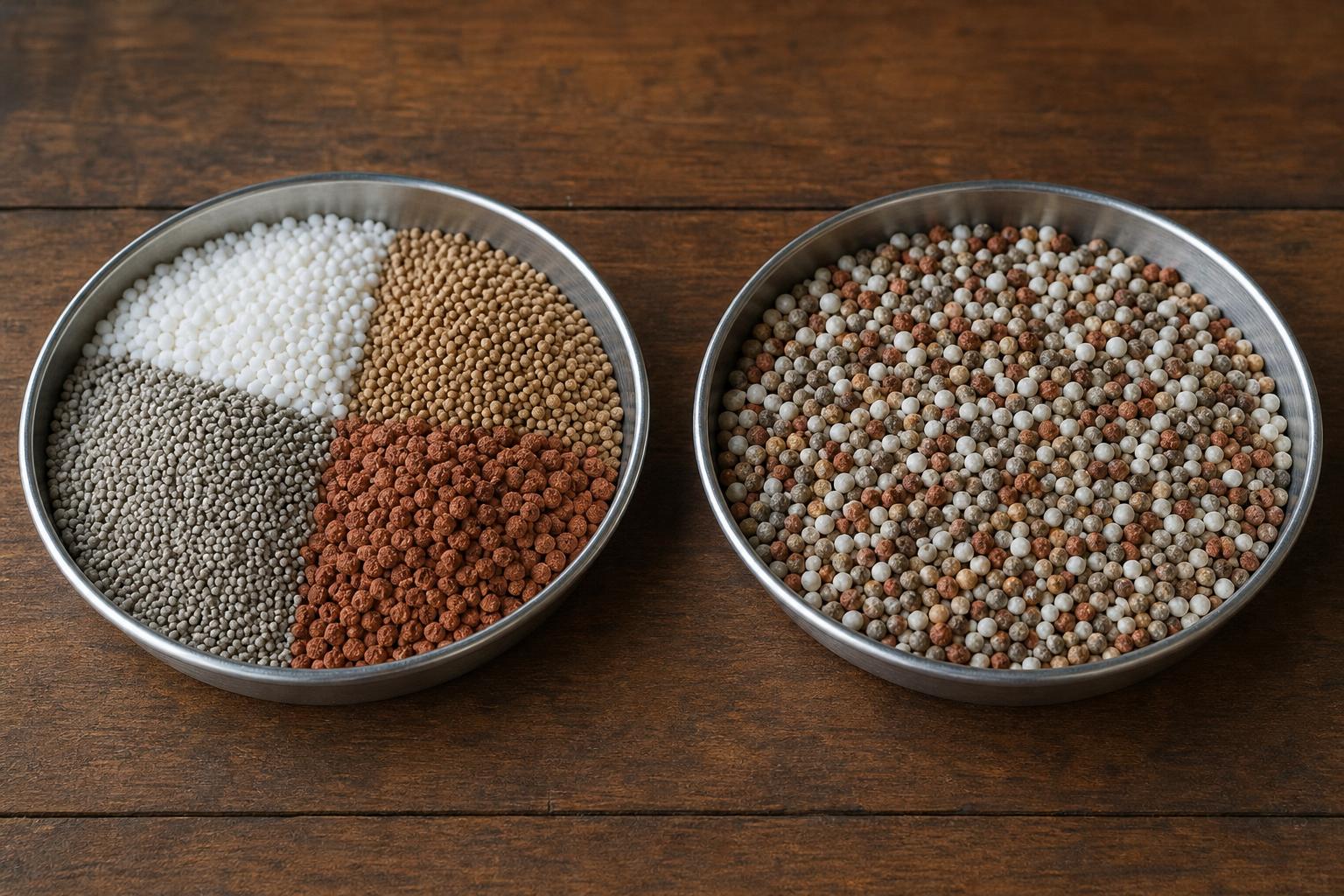
Choosing between a fertiliser blend vs compound fertiliser comes down to three practical questions: how evenly will every square metre of paddock receive nutrients, how likely is the product to separate between the factory and the field, and how closely can you tailor it to a soil test? A compound fertiliser puts nitrogen, phosphorus and potassium into every granule. A blend mixes separate granules that each carry different nutrients. Neither is better in every situation. This guide explains how uniformity, segregation risk and flexibility differ, gives a clear decision guide, and shows how to specify an order so the product you receive performs as intended. It is written for growers, resellers and agronomists buying in commercial quantities anywhere in the world.
In this article
- Key takeaways
- Fertiliser blend vs compound fertiliser: what actually differs
- Nutrient uniformity: what each granule delivers
- Segregation risk in blended fertiliser
- Flexibility: where a custom blend wins
- Side-by-side comparison of compound, blended and water-soluble products
- When to choose compound, blended or water-soluble
- How to specify and check an order
- Conclusion
Key takeaways
- A compound (complex) fertiliser carries the same nutrient ratio in every granule, so uniformity is built into the product and cannot be lost by handling.
- A blended fertiliser mixes different granules, so its uniformity depends on how well the components match in size, density and shape, and on how carefully it is handled.
- Blends offer far more flexibility: ratios, sulphur and trace elements can be set to a soil test rather than to a fixed grade.
- Segregation risk is manageable, not a reason to avoid blends. Matched granules, fewer handling steps and sensible storage reduce it greatly.
- Choose compound for low rates, uniform spread and simple logistics. Choose a blend when the soil test calls for a ratio that standard grades do not offer.
Fertiliser blend vs compound fertiliser: what actually differs
Both products deliver the same nutrients. The difference is where those nutrients sit: inside one granule, or spread across several different granules mixed together.
What a compound fertiliser is
A compound fertiliser, often called a complex or NPK compound, is manufactured so that each granule contains nitrogen, phosphorus and potassium in a fixed ratio. Raw materials are reacted, granulated or prilled together, then dried, sized and screened. A grade such as 15-15-15 means every granule has roughly that analysis. Products made in a prilling tower are commonly called high tower compound fertilisers and are discussed in our guide to high tower compound fertiliser.
What a blended fertiliser is
A blended fertiliser, also called a bulk blend, is a physical mixture of straight or compound materials such as urea (46-0-0), DAP or MAP, and potassium sulphate (SOP) or muriate of potash. Each granule has one dominant nutrient profile. The blend analysis exists only as an average across the whole mixture, so the quality of the mixing and the match between components matter a great deal.
Terms differ between countries
Vocabulary and labelling rules vary. Some regions say complex fertiliser where others say compound; some use bulk blend, others simply blend. Declared-analysis tolerances, labelling and permitted ingredients are set nationally, so check the rules where the product will be used. For a shorter overview, see our page on compound vs blended fertiliser.
Nutrient uniformity: what each granule delivers
Uniformity is the strongest argument for compound products. It is also the most misunderstood, because paddock-scale uniformity depends on granule numbers as well as granule composition.
Granule counts and spread
As a rough guide, a kilogram of 2 to 4 mm granules contains tens of thousands of granules. At 200 kg/ha (about 180 lb/ac), which is 20 g per square metre, a crop may receive several hundred granules per square metre. In a three-component blend, each component supplies only a fraction of those. At a low rate of 50 kg/ha (about 45 lb/ac), the count falls to well under a hundred granules per square metre for each component, and a small trace-element fraction may be only a handful. Every missing or doubled granule then represents a larger share of the dose.
With a compound, each granule that lands carries all nutrients, so even a sparse pattern gives the right ratio locally. With a blend, a sparse pattern can mean a plant receives nitrogen but no potassium nearby.
Where uniformity matters most
- Low application rates and small-seeded or shallow-rooted crops, where fewer granules mean more patchiness.
- High-value horticulture and row crops, where an imbalance near the root zone can show up as variable quality or yield.
- Micronutrient delivery, where only a few grams per hectare of an element must be spread evenly.
- Wide spreader swaths, where different granules are thrown different distances.
One caveat: compound granules can still vary in size, and large and small granules spread differently. The nutrient ratio stays constant, but the rate can vary across the swath. Good screening matters for both product types.
Segregation risk in blended fertiliser
Segregation is when the components of a blend separate, so that part of a load, a bag or a paddock receives a different analysis than intended. It is the main technical weakness of bulk blends, and it is largely preventable.
Why blends separate
Granules of different size, density or shape move differently when a mixture flows, falls or vibrates. The usual mechanisms are:
- Sifting: small granules fall through gaps between larger ones during vibration or pouring.
- Trajectory: larger or denser granules travel further when discharged or thrown from a spreader.
- Fluidisation and dusting: fine, light particles collect in the air or at the top of a pile.
- Cone formation: when a pile builds under a conveyor, coarser granules roll to the outside and fines stay in the centre.
Where it happens between factory and field
Every transfer is an opportunity: loading a truck, tipping into a shed, scooping into a hopper, filling a spreader and driving across rough ground. Long vibration on a road or a rail wagon encourages sifting. Taking the first and last portions from a pile often shows the largest deviation.
How to reduce the risk
- Choose components with closely matched granule size distribution and similar density. This is the single most effective control.
- Keep the number of handling steps and drop heights to a minimum, and avoid building tall cone piles.
- Where practical, load the spreader from the delivered form without further re-handling, and keep partly used loads covered and dry.
- Choose the delivery format sensibly. Our guide on bulk, bulka bag or bagged delivery explains how format affects handling steps.
- Where documented quality evidence is needed, ask for a Certificate of Analysis, which we provide on request.
Flexibility: where a custom blend wins
If uniformity is the strength of compound products, flexibility is the strength of blends. Standard compound grades are designed for broad use. A blend can be designed for one soil, one crop and one budget of nutrients.
Matching the soil test
A soil test may show phosphorus is adequate, potassium low and sulphur marginal. A fixed grade such as 15-15-15 would add phosphorus you do not need. A blend can supply only what the test and crop plan justify. Our guide on how to read a soil test report explains the key fields, and our worked example of custom fertiliser blending shows how results become an order.
Adding sulphur, trace elements or changing ratios
Blending lets you choose the nitrogen source (for example urea for concentration), the phosphorus source (DAP or MAP) and a chloride-free potassium source such as SOP for sensitive crops. You can also adjust the ratio between seasons, paddocks or crop stages without waiting for a new grade to be produced.
Compatibility limits
Flexibility is not unlimited. Some materials should not be mixed because they attract moisture, release heat or become sticky. Urea combined with certain superphosphates or with ammonium nitrate can cause caking and handling problems, and fine or very hygroscopic components make segregation and storage harder. A competent blender will confirm which components are compatible and for how long a blend can be stored before use. Rules on permitted blends also vary between countries.
Side-by-side comparison of compound, blended and water-soluble products
The table below summarises how the three most common options compare on the factors that matter most in the paddock. Water-soluble products are included because they sit outside the blend-or-compound debate for fertigation and foliar use.
| Factor | Compound (NPK granule) | Blended fertiliser | Water-soluble fertiliser |
|---|---|---|---|
| Nutrient uniformity | Same ratio in every granule | Depends on mixing and granule match | Fully dissolved, uniform in solution |
| Segregation risk | Very low for nutrient ratio | Present; managed by matching and handling | Not applicable once dissolved |
| Flexibility of ratio | Limited to available grades | High; set to the soil test | Moderate; chosen by formulation |
| Best application method | Broadcast, banded, topdressed | Broadcast or banded with suitable equipment | Fertigation, foliar, drip |
| Low-rate suitability | Good | Fair; needs careful size matching | Good |
| Handling steps that affect quality | Few | Several; keep to a minimum | Dissolving and tank management |
No column wins on every row. The right option depends on your soil, crop, equipment and supply chain.
When to choose compound, blended or water-soluble
Use the lists below as a decision aid, then confirm with your agronomist.
Choose compound when
- Application rates are low or crops are sensitive to patchy nutrition.
- A standard NPK ratio fits your soil test and crop plan reasonably well.
- Product will be stored, trucked long distances or handled several times before spreading.
- Operators prefer a simple, single-product pass.
- You are supplying a reseller network where consistent product from bag to bag matters.
Choose a blend when
- Soil tests show an uneven profile, such as adequate phosphorus but low potassium or sulphur.
- You need a nitrogen-heavy ratio that standard compounds do not provide, as in many cereal and pasture programmes.
- You manage many paddocks with different needs and want one order tailored to each.
- Components can be matched in granule size and the product will move through few handling steps.
- You want to choose specific sources, for example a chloride-free potassium source for sensitive crops.
Consider water-soluble when
You apply nutrients through irrigation or foliar sprays, or need rapid, precise delivery in protected cropping or orchards. Water-soluble products avoid granule segregation entirely but require suitable equipment and compatible water quality.
Mixed approaches are common. Many growers apply a compound base and top up nitrogen or sulphur with a straight product or a small custom blend.
How to specify and check an order
Many blend problems begin with a vague order. A clear specification protects uniformity whichever product you choose.
What to include in an enquiry
- Your soil test results and the target crop, rate and timing.
- The nutrient analysis you want, or the nutrient amounts per hectare (or per acre) you are aiming for.
- How the product will be stored and applied, including spreader type and delivery format.
- Destination and quantity. Our minimum order is 10 to 25 MT depending on product and destination, and a full 20 ft container is about 25 MT (roughly 27.5 US short tons).
We quote each enquiry individually in writing, with grade, quantity and lead time confirmed in the quotation. If you are comparing offers, our article on how to compare bulk NPK quotes helps you compare like with like. Note that regulations and labelling differ by country.
Checking the product on arrival
- Inspect the load visually for fines, dust, lumps or obvious colour bands suggesting separation.
- Compare the delivered product with the grade and components written in the quotation.
- Where you need analytical evidence, use the Certificate of Analysis on request and the paperwork provided.
- Take composite samples from several points rather than one scoop if you plan independent testing.
Quantities and logistics
Storage and spreader-fill practices after delivery strongly influence field uniformity. Keep product dry, covered and off bare ground, avoid tall cone piles, and fill spreaders with minimal drop. Payment terms and shipping details are set out in the written quotation.
Conclusion
Compound fertilisers carry the same nutrient ratio in every granule, which makes them reliable for uniform spread and low rates. Blended fertilisers trade some of that built-in uniformity for the freedom to match a soil test precisely. Segregation is the cost of that freedom, and it is controlled by matched granules, few handling steps and careful storage. Choose by rate, crop sensitivity, handling chain and how closely a standard grade fits your soil. Whichever you choose, specify the order clearly and check the product on arrival.
Frequently asked questions
What is the main difference between a blended and a compound fertiliser?
A compound fertiliser has several nutrients combined in every granule, so each granule has the same analysis. A blended fertiliser is a physical mixture of separate granules, each carrying different nutrients. The blend analysis is an average across the whole mixture.
Is compound fertiliser better than a blend?
Neither is better in every case. Compound gives built-in uniformity and low segregation risk, which helps at low rates and with long handling chains. Blends give more flexibility to match a soil test and can suit programmes that need unusual ratios.
Does blended fertiliser always segregate?
No. Segregation is a risk, not a certainty. It is greatly reduced when components have similar granule size and density, when handling steps and drop heights are limited, and when blends are stored and loaded carefully.
How can I reduce segregation in a bulk blend?
Use components with closely matched size and density, avoid building tall cone piles, minimise transfers, and keep product dry and covered. Choosing a delivery format that suits your handling chain also helps. A Certificate of Analysis can document the analysis supplied.
What is NPK compound fertiliser?
NPK compound fertiliser is a granular product made so each granule contains nitrogen (N), phosphorus (P) and potassium (K) in a fixed ratio. Grades such as 15-15-15 describe the percentage of each nutrient. It may be made by granulation or in a prilling tower.
When should I choose a custom blend based on a soil test?
Choose a custom blend when your soil test shows nutrient needs that standard compound grades do not match, for example adequate phosphorus but low potassium or sulphur. It lets you apply only the nutrients the crop plan justifies. Ratios can be adjusted between paddocks or seasons.
Can I mix any fertilisers together in a blend?
No. Some combinations attract moisture, cake or become sticky, such as urea with certain superphosphates or ammonium nitrate. A blender should confirm compatibility and storage limits. Rules about permitted mixtures also differ between countries.
What minimum order does Natures Fertilizer supply?
Our minimum order is 10 to 25 MT depending on product and destination, and a full 20 ft container is about 25 MT. We supply growers, resellers and agronomy businesses in commercial quantities. Each enquiry receives an individual written quotation.
Leave a Reply