
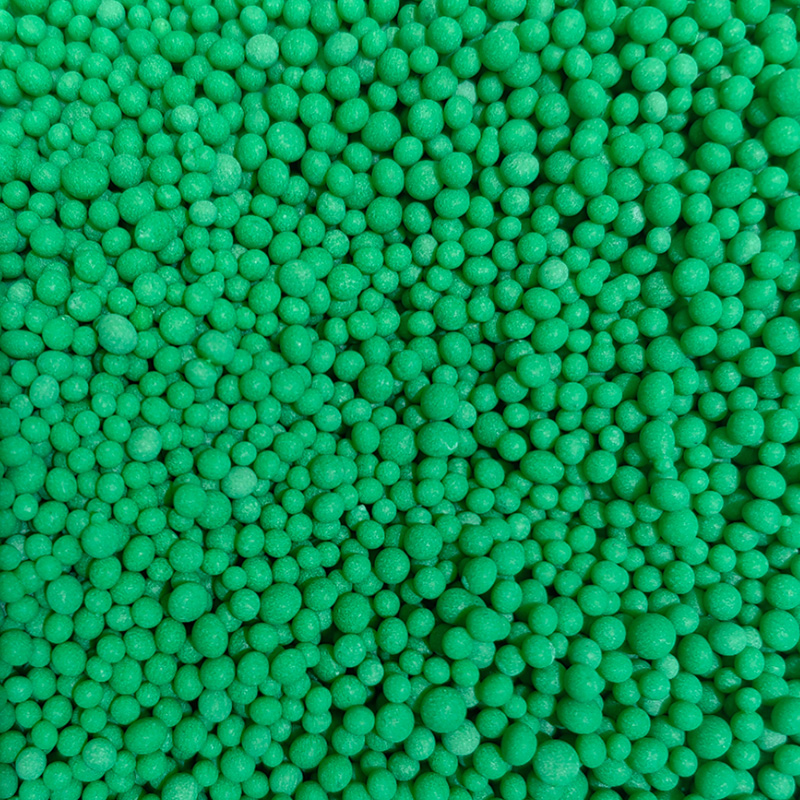
High tower is the largest single family in our range — 36 analyses — and it is the one buyers most often order without knowing what the name means. It describes how the granule was made, and that turns out to matter more than most people expect.
What the tower actually does
In tower granulation, a hot concentrated melt is sprayed from the top of a tall tower. The droplets cool and solidify as they fall, forming granules that are close to spherical and hard the whole way through. There is no separate drying stage, because the granule solidifies from a melt rather than being built up in layers.
Conventional compounding builds granules by rolling and layering damp material, then drying it. That produces a serviceable granule, but a less uniform and slightly softer one.
Why roundness and hardness are worth money
Spread pattern
A spinner throws by flinging particles off a disc. How far a particle goes depends on its mass, its shape and how it tumbles. Round, uniform, dense granules follow a predictable arc; irregular ones scatter. At 12 metres nobody notices. At 24, 30 or 36 metres the difference shows up as striping in the crop.
If you spread wide, granule uniformity is not a detail — it is most of what determines whether the paddock actually receives the rate you paid for.
Dust and breakdown
Every transfer — auger, belt, tipping, spreader — abrades granules. Softer ones shed fines that block screens, drift on the wind and land where they were not aimed. A harder granule survives handling, which matters most when the product is carted a long way or handled several times.
Storage
Denser, harder granules with less surface area take up moisture more slowly. That does not make them immune — store any fertiliser dry and off the ground — but it buys time.
What it does not change
Tower granulation is a manufacturing method, not an agronomic one. A 16-16-16 high tower product and a 16-16-16 conventional compound deliver the same nutrient. The crop cannot tell the difference; the spreader can.
It also does not make it a slow-release product. The nutrient is as available as any other compound of the same analysis.
When to choose it, and when not to bother
| Your situation | Worth it? |
|---|---|
| Spreading 24 m or wider | Yes — this is where it pays |
| Product will be carted far or handled several times | Yes |
| Storing for a while before spreading | Yes |
| High-value crop where evenness shows in the result | Yes |
| Narrow spreading width, product used straight away | A conventional compound is usually the better buy |
| No standard grade fits your soil test | A blend beats either, and matching the analysis matters more |
Browse the 36 high tower analyses, or compare with compound versus blended if you are still deciding on the format.
Tell us your spreading width, the analysis you need and the tonnage, and we will tell you honestly whether the high tower premium is worth it for you.