
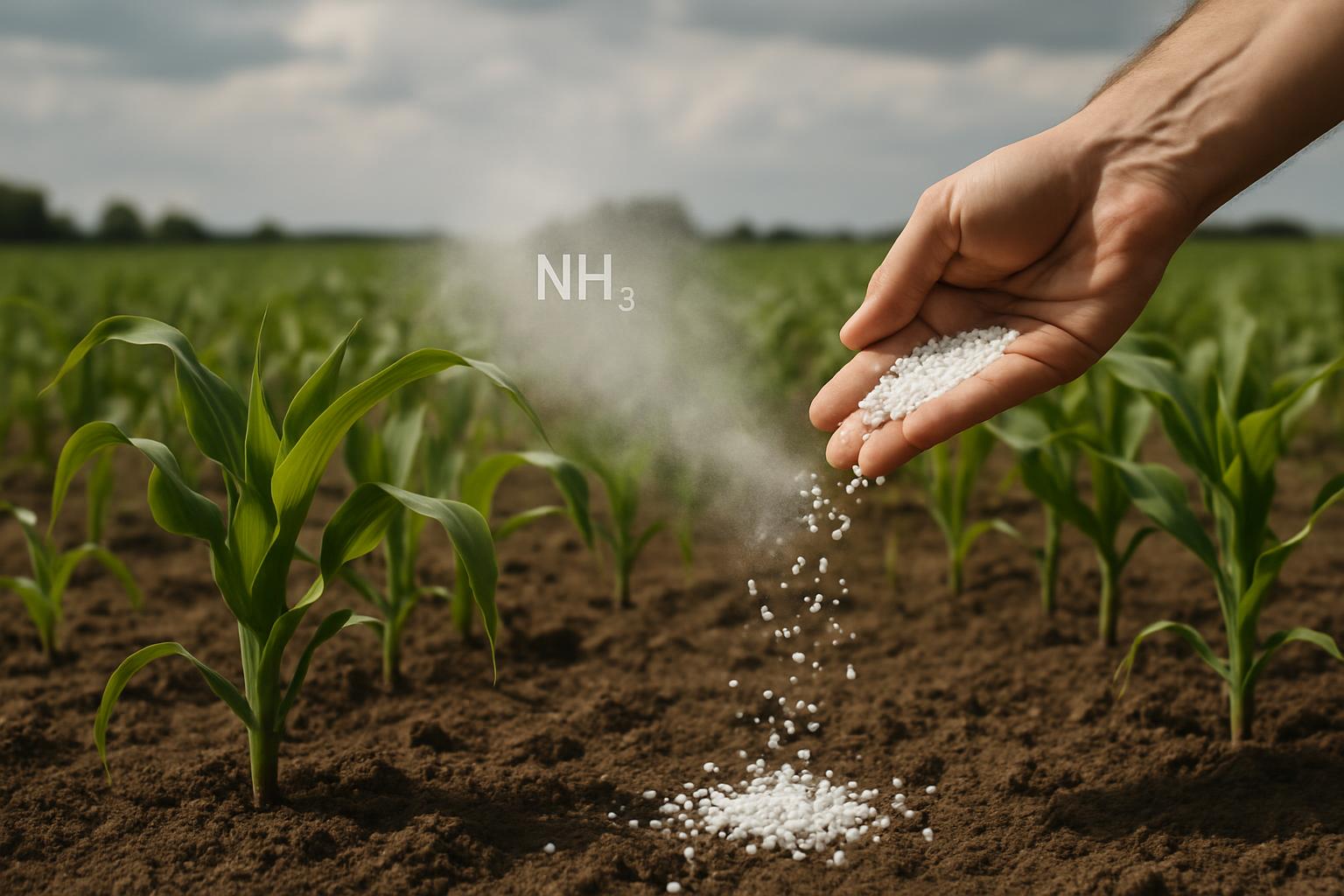
Urea volatilisation loss is one of the quietest ways to waste money on a farm. Urea (46-0-0) is the most widely used nitrogen fertiliser in the world because it is concentrated and easy to handle, but when it sits on the soil surface it can convert to ammonia gas and drift away before a crop root ever reaches it. The loss is invisible, which is why it is often blamed on “a poor season” instead. The good news is that it is largely controllable. Timing, moisture and incorporation decide how much nitrogen you keep, and none of them require new machinery. This guide explains the chemistry in plain terms, then gives specific, practical steps that apply to broadacre, pasture, horticulture and irrigated systems in any country.
In this article
- Key takeaways
- How urea volatilisation loss actually happens
- What drives nitrogen loss from urea
- Urea application timing: matching spreading to rain and temperature
- Moisture: the factor most often misjudged
- Incorporating urea so it stays in the soil
- Urease inhibitors and other ways to reduce urea loss
- Managing urea leaching and denitrification after the ammonia risk passes
- A practical pre-spreading checklist and ordering notes
- Conclusion
Key takeaways
- Urea left on the surface can lose a large share of its nitrogen as ammonia gas, and losses above 30% are documented under warm, humid, residue-covered conditions.
- The goal is to move urea into the soil, by rain, irrigation or machinery, within a few days of spreading, ideally before the urea has fully hydrolysed.
- Light rain (under about 5 mm or 0.2 in) and dew are the worst moisture scenarios because they start the reaction without carrying urea down.
- Placing urea 5 cm (2 in) or deeper, or banding it, cuts ammonia loss sharply compared with broadcasting onto stubble or pasture.
- Urease inhibitors, alternative N sources and split applications are useful tools, but only after timing and incorporation are right.
- Leaching and denitrification are separate losses that matter most on sandy, waterlogged or compacted soils.
How urea volatilisation loss actually happens
Understanding the mechanism makes every management step easier to justify, because each step targets one part of the chain.
From granule to ammonia gas
Urea is not directly plant-available in the form most crops prefer. Once it contacts moisture, the enzyme urease, which is present in soil, plant residue and microbes, breaks urea down into ammonium carbonate. This typically takes from one to a few days in warm, moist conditions and longer in cold weather. Ammonium carbonate then splits into ammonium (NH4+), which soil can hold, and ammonia (NH3), a gas. If this reaction happens on the soil surface or within the top centimetre, the ammonia escapes to the atmosphere instead of being held on soil particles.
Why pH around the granule matters
As a granule dissolves, it creates a small zone where pH can rise to around 8.5 to 9, even in a neutral or acidic soil. At higher pH more of the nitrogen exists as ammonia gas rather than ammonium. That is why a soil with a pH of 5.5 can still show real volatilisation from urea, and why alkaline or calcareous soils are at greater risk again. Soils with low cation exchange capacity (CEC) hold less ammonium, so more is free to escape.
Volatilisation, leaching and denitrification compared
Three different mechanisms are often grouped as “nitrogen loss from urea”. They need different responses.
| Loss pathway | Form lost | When it peaks | Main control |
|---|---|---|---|
| Volatilisation | Ammonia gas | Days 1-7 after surface spreading | Incorporation, timing, inhibitors |
| Leaching | Nitrate (sometimes urea itself) | Weeks after application, after heavy rain | Split doses, matching rate to crop demand |
| Denitrification | Nitrous oxide and nitrogen gas | Waterlogged, warm soils | Drainage, avoiding application before saturation |
What drives nitrogen loss from urea
No two paddocks lose the same amount. Several factors multiply together, which is why the same rate on the same farm can perform very differently between years.
Weather and soil conditions
Warm temperatures speed up urease activity, so hydrolysis in summer or in tropical climates can finish in a day or two. Wind strips ammonia away from the surface. A surface that is moist then drying out, as happens with dew or a light shower followed by sun, pushes ammonia into the air. Soils with high pH, low CEC and low buffering capacity (often light-textured soils) lose more.
Residue, surface and spreading conditions
Crop stubble, pasture thatch and mulch carry a lot of urease. Urea landing on heavy residue can hydrolyse faster and be physically separated from the soil by the trash layer, so rain may wash it off the residue without reaching mineral soil. Zero-till and no-till systems, grazed pastures and sugarcane trash blankets are therefore higher-risk. Animal urine patches in pasture add to the problem.
Clues in your soil test
A soil test will not predict a particular spreading event, but it shows risk. Look at pH, CEC, organic carbon and texture. Our guide on how to read a soil test report walks through those fields. As a rough rule, high pH combined with low CEC means choosing incorporation or a different nitrogen source should be a priority rather than an afterthought.
Urea application timing: matching spreading to rain and temperature
Urea application timing is the cheapest tool you have. It costs nothing to change, and it often matters more than product choice.
Spreading ahead of rain
The classic advice is to spread urea just before rain. It is sound, but with conditions attached. You generally need around 10 mm (0.4 in) of rain, in a single event or within a day or two, to wash urea into the soil far enough to reduce ammonia loss. Less than about 5 mm (0.2 in) can start hydrolysis without moving the urea down. Forecasts are uncertain, so look for a rain event with a high probability of at least 10 mm within 48 hours, and avoid spreading if the forecast is only for showers. Also avoid spreading before intense storms on sloping ground, where runoff can carry dissolved urea off the paddock.
Cool versus warm conditions
Cool soil slows urease, giving rain more time to arrive. In temperate winter cropping, spreading urea in cool conditions carries lower volatilisation risk than the same pass in warm weather. Cold, however, is not a free pass. Waterlogging in cold, wet winters raises leaching and denitrification risk, so the answer is not “always spread early.” In hot, humid climates, aim for incorporation immediately or use a placement method that does not leave urea on the surface at all.
Splitting nitrogen across crop stages
Putting all nitrogen on at sowing exposes the whole dose to loss for the longest time. Splitting into two or three passes, matched to uptake, reduces exposure and leaves you the option to adjust the later dose when the season turns out wetter or drier than expected. Crops such as canola and wheat have peak demand during stem elongation; our notes on fertiliser for canola, nitrogen and sulphur give an example of how crop stage shapes the plan. Timing recommendations differ by climate, so always check local agronomic guidance.
Moisture: the factor most often misjudged
Moisture is the pivot. Too little, and urea sits unreacted; too much at the wrong time, and you lose nitrate. The most dangerous pattern is a small amount of moisture that triggers the reaction without carrying urea into the soil.
Dew and light showers
Dew, fog and showers under 5 mm (0.2 in) dissolve the granule and wake up urease, but leave the nitrogen in the top few millimetres. When the sun comes out and the surface dries, ammonia leaves with the evaporating water. Spreading in the evening onto a surface that will be wet with dew overnight is therefore not neutral. If you have no rain or irrigation coming, spreading onto a dry surface and incorporating mechanically is safer than hoping for a shower.
Irrigation as an incorporation tool
On irrigated land you control the rain. Applying roughly 10 to 15 mm (0.4 to 0.6 in) of water soon after spreading, within a day for warm conditions, moves urea into the soil. Over-irrigating, however, pushes mobile nitrogen below the root zone, so avoid large applications of water that exceed what the soil can hold. Fertigation with a water-soluble fertiliser places nitrogen directly in the wetted zone and sidesteps surface loss, although it carries its own cost and scheduling considerations.
Spreading onto dry soil
Dry, cool soil with no surface moisture is the lowest-risk surface condition, because urea granules remain intact and unreacted. The risk resumes when moisture arrives. For this reason, spreading ahead of a reliable break in rain, especially in dry-season systems, can work well, provided there is enough rain to wash the urea in, not just wet it.
Incorporating urea so it stays in the soil
Incorporation puts urea in contact with soil particles that can hold ammonium and out of reach of the wind. It is the single most reliable way to reduce urea loss when rainfall is uncertain.
Mechanical incorporation and banding
Working urea into the soil at 5 cm (2 in) or more, with a harrow, tine or disc pass, generally gives strong protection, because ammonia produced at depth is re-captured by soil as it moves upward. Banding concentrates nitrogen, which can raise local pH and ammonium concentration, so keep urea away from seed to avoid germination damage. Safe seed-placed rates vary widely by crop, row spacing, seedbed utilisation and soil moisture, so use local guidance, and keep seed-contact rates low or zero for sensitive crops.
Side-dressing and drilling
For row crops, side-dressing into a furrow and covering it protects nitrogen and positions it near the roots. In no-till systems, deep banding or drilling is the equivalent. This reduces trash contact, which is a major issue in stubble-retained systems.
Rain or irrigation as incorporation
When machinery is not practical, as in established pasture, orchards or standing cereals, rainfall or irrigation is the only incorporation available. Use the 10 mm rule above, spread in cooler parts of the day or season, and consider treated urea or an alternative nitrogen source. For grass and hay systems, see fertiliser for pasture and hay for how these decisions play out under grazing and cutting regimes.
Urease inhibitors and other ways to reduce urea loss
Once timing and incorporation are as good as they can be, product-based options cover the remaining risk, particularly where surface application is unavoidable.
How NBPT-type inhibitors work
Urease inhibitors, commonly based on NBPT, temporarily block the urease enzyme. This slows hydrolysis, giving rain or irrigation more time to arrive. Protection typically lasts several days to a couple of weeks depending on temperature and soil, and it is not permanent. Inhibitors are most valuable when the forecast is uncertain, residue is heavy, or spreading must happen onto pasture. They do not protect against leaching or denitrification. Product availability, registration and labelling rules vary between countries, so check what is permitted and supplied in your region. For exports or bulk orders, confirm treated urea availability and specification in the written quote rather than assuming it.
When ammonium sulphate makes more sense
Ammonium sulphate carries nitrogen already in the ammonium form, so it does not rely on urease, and on non-calcareous soils it usually shows lower ammonia loss than urea. It also supplies sulphur. It is less concentrated in nitrogen, so freight per unit of N is higher, and it acidifies soil more. Our comparison of ammonium sulphate vs urea sets out the trade-offs. On high-pH or calcareous soils, ammonium sources can also lose ammonia, so soil pH remains the deciding factor.
Compound and blended options
Where a crop needs phosphorus, potassium and sulphur as well as nitrogen, a compound NPK or a custom blend can place a share of nitrogen with other nutrients so that fewer passes are needed. Compound and blended products do not remove volatilisation risk if the nitrogen is urea, but they reduce the number of spreading events. A blend built from your soil test also helps ensure that you are not spreading extra nitrogen to compensate for a deficiency that is actually phosphorus or sulphur.
| Strategy | Best for | Limits |
|---|---|---|
| Mechanical incorporation or banding | Cropping with seedbed access | Needs machinery and a safe distance from seed |
| Timing before 10 mm or more of rain | Pasture, standing crops | Forecasts are uncertain; light rain can make it worse |
| Urease inhibitor | Surface application, heavy residue | Temporary; no effect on leaching |
| Ammonium sulphate | Sulphur-responsive crops, acidic or neutral soils | Lower N content; acidifying |
| Split applications | Long-season crops, wet or sandy sites | More passes and labour |
Managing urea leaching and denitrification after the ammonia risk passes
Avoiding ammonia loss in the first week does not finish the job. Urea that reaches the soil becomes ammonium, then nitrate within weeks in warm soil, and nitrate is mobile.
Sandy and free-draining soils
Urea leaching is mainly a nitrate story on light soils with low water-holding capacity. Heavy rain or over-irrigation moves nitrate below the root zone, and in some situations urea itself can move before it hydrolyses. Reduce risk with smaller, more frequent doses, applications timed with active crop uptake, and rates matched to a realistic yield target. Pay attention to groundwater protection rules, which differ by country and region and may restrict timing or rates in some areas.
Waterlogged and compacted soils
When soil is saturated and warm, microbes use nitrate as an oxygen source and release nitrous oxide and nitrogen gas. That is denitrification loss, and it is also a greenhouse gas emission. Avoid spreading nitrogen ahead of forecast waterlogging, improve drainage where possible, and fix compaction. Delaying a dose until the soil drains is often cheaper than replacing lost nitrogen later.
A practical pre-spreading checklist and ordering notes
Use a short checklist so decisions are made on conditions rather than habit.
Seven checks before the spreader leaves the shed
- Check soil pH, CEC and texture from your latest test to rank the paddock’s risk.
- Look at the surface: heavy stubble or thatch means higher risk and a greater need for placement or an inhibitor.
- Review the 48-hour forecast for rain amount, not just rain probability. Aim for 10 mm (0.4 in) or more, or plan mechanical incorporation.
- Check temperature and wind. Hot, windy days raise ammonia loss on bare urea.
- Decide how much nitrogen is needed now and how much can wait for a split dose.
- Confirm that seed-contact and row safety limits are respected if urea is banded or drilled.
- Record date, rate, weather and incorporation so that results can be compared next season.
Planning bulk orders around timing
Timing is also a logistics question. A load of urea that arrives late in a dry spell, or a storage plan that forces you to spread everything in one weather window, pushes you towards spreading in poor conditions. Ordering ahead, staggering deliveries and matching quantities to your split plan gives you the flexibility to wait for good conditions. At Natures Fertilizer Pty Ltd we supply bulk and bagged Urea 46-0-0 alongside DAP, MAP, potassium sulphate (SOP), compound NPK and organic products, and we blend to match your soil test, with each quote provided individually in writing. For what to check on loads and ports, see buying urea in bulk in Australia. If you want nitrogen, phosphorus and sulphur planned together, our worked example of custom fertiliser blending shows the steps from soil test to order.
Conclusion
Urea volatilisation loss happens when urea hydrolyses at or near the soil surface and ammonia escapes as gas. Warm weather, wind, high pH, low CEC, heavy residue and light rain all increase it. The practical response is to move urea into the soil quickly, using rain of about 10 mm (0.4 in) or more, irrigation or machinery, to time applications for cooler and calmer conditions, and to use inhibitors or alternative nitrogen sources where surface spreading is unavoidable. Split doses and attention to drainage then address leaching and denitrification. Check your soil test, watch the forecast, and keep records so each season’s decisions improve the next.
Frequently asked questions
How much nitrogen can be lost from surface-applied urea?
Losses vary widely, from close to zero in cool, dry conditions to more than 30% in warm, humid or residue-covered situations with no incorporation. Soil pH, temperature, wind, rainfall and the amount of surface residue all influence the result. Because the loss is a gas, it is rarely visible in the paddock.
How much rain do I need after spreading urea?
About 10 mm (0.4 in) within a day or two is a commonly used guide for moving urea into the soil. Less than about 5 mm (0.2 in) can start the reaction without carrying urea down, which may increase ammonia loss. The exact amount depends on residue, soil type and temperature.
How long does urea take to turn into ammonia?
Hydrolysis often takes from one to a few days in warm, moist soil, and longer in cold conditions. Most ammonia loss usually occurs in the first week after surface spreading. This is why quick incorporation matters.
Does urea leach?
Urea itself is mobile and can move with water before it is converted, but most leaching losses involve nitrate formed later from ammonium. Sandy soils and heavy rain or over-irrigation carry the highest risk. Smaller, split doses matched to crop uptake help reduce it.
Do urease inhibitors always work?
They delay hydrolysis for several days to around two weeks, depending on temperature and soil, giving rain or irrigation more time to arrive. They do not stop leaching or denitrification, and they cannot replace good timing and incorporation. Availability and regulations differ between countries.
Is ammonium sulphate better than urea for avoiding ammonia loss?
On non-calcareous soils it usually shows lower ammonia loss because the nitrogen is already in ammonium form, and it supplies sulphur. It has lower nitrogen content and is more acidifying, so freight and soil pH need consideration. On high-pH or calcareous soils the advantage shrinks.
Is it safe to put urea in the seed row?
Safe rates depend on crop, row spacing, soil moisture and seedbed conditions, and urea can damage germinating seedlings through ammonia and salt effects. Many guidelines advise keeping seed-placed urea very low or avoiding it for sensitive crops. Use local agronomic advice and band away from seed where possible.
Leave a Reply