
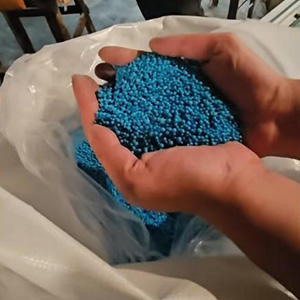
Two fertilisers can carry the identical analysis on the bag and behave completely differently in the spreader. The difference is whether the nutrients are combined inside every granule, or whether granules of different products have been mixed together.
What separates them
| Compound | Blended | |
|---|---|---|
| How it is made | Nutrients combined chemically during manufacture | Straight granular products physically mixed |
| Each granule contains | The full declared ratio | One nutrient source |
| Segregation risk | None | Real, if granule sizes differ |
| Spread uniformity | High | Depends on granule matching |
| Analysis flexibility | Fixed grades | Any ratio you need |
| Cost | Higher | Generally lower |
Browse compound fertilisers · Browse blended fertilisers · High tower compounds
Segregation: the risk you are paying to avoid
In a blend, granules of different products travel together. If they differ in size, density or shape, they separate — in the bag during transport, in the bin as it empties, and off the spinner as it throws.
The consequence is not an averaging-out. It is stripes. One part of the paddock gets the nitrogen, another gets the potassium, and the analysis you paid for is not what any single square metre receives. On wide spreading widths the effect is worse, because heavier particles throw further than lighter ones.
A well-made blend using size-matched granules from a supplier who controls the raw material largely avoids this. A badly made one does not, and you will not see the problem until the crop shows it.
In a compound, segregation is physically impossible. Every granule is the same. That is what the price premium buys.
Flexibility: what blending buys instead
Compound grades are fixed. You choose the nearest one to what your soil test asked for and accept the compromise — usually over-supplying one nutrient to get enough of another.
A blend can be built to any ratio. If your test calls for a nitrogen-led product with a lift in potassium and some sulphur, a blend delivers precisely that. Over a season and across a property, matching the analysis properly often saves more than the compound premium costs.
That is the real trade-off: compound buys uniformity, blending buys accuracy.
Where high tower compounds fit
High tower granulation produces a harder, rounder, more uniform granule than conventional compounding. Rounder granules throw more predictably, which matters on wide spreading widths, and harder granules produce less dust and break down less in handling. Where you are spreading wide and want compound uniformity, it is the better-performing option.
Quick answer
| Your situation | Choose |
|---|---|
| Wide spreading widths (24 m and above) | Compound |
| Product will be stored or carted a long way before use | Compound |
| High-value crop where evenness pays | Compound |
| A standard grade genuinely matches your test | Compound |
| No standard grade fits your soil test | Blend |
| You need sulphur or trace elements included | Blend |
| Cost per unit of nutrient is the priority | Blend |
| Spreading soon after delivery | Blend |
What to ask before you order a blend
- Are the granules size-matched, and what raw materials is it built from?
- What is the tolerance on the declared analysis?
- How long can it be stored before segregation becomes a risk?
- Is a Certificate of Analysis available for the batch?
A supplier who cannot answer those four questions is not blending carefully enough.
Send us your soil test and we will tell you honestly whether a standard compound fits or whether a blend will serve you better.
Leave a Reply