
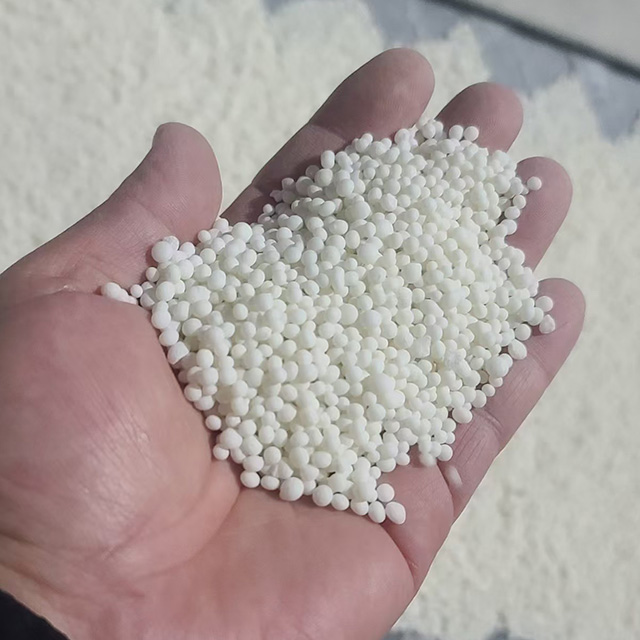
Wheat is the largest single fertiliser decision most Australian growers make, and it splits cleanly into two: what goes down at seeding, and what goes on afterwards.
At seeding: phosphorus does the work
Early root architecture is set in the first few weeks, and phosphorus drives it. Because phosphorus is immobile in soil, the seedling can only reach what is physically near it — which is why banding at seeding outperforms broadcasting the same rate, and why a starter matters even on soils testing adequate.
The usual choices:
| Product | Analysis | Where it fits |
|---|---|---|
| DAP | 18-46-0 | The default starter. More nitrogen than MAP, but an alkaline reaction zone — keep it off the seed in dry or sandy conditions |
| MAP | 12-61-0 | Higher phosphorus, acidic reaction. Safer next to the seed and often better on alkaline and calcareous soils |
| Compound NPK | e.g. 15-15-15, 16-16-16 | Where the soil test wants potassium at seeding as well — common on sands |
Which of DAP or MAP wins depends on your soil pH and your seeding setup rather than on price alone — we compared them in detail in DAP vs MAP.
Through the season: nitrogen sets the yield
Nitrogen is the lever on yield and protein, and it is the decision most exposed to the season. Applied too early it can be lost before the crop needs it; too late and the crop has already set its potential.
Urea 46-0-0 is the standard because it carries the most nitrogen per tonne — 460 kg — so you cart and spread fewer tonnes for the same nitrogen. The trade-off is volatilisation: surface-applied urea on warm moist soil can lose a meaningful share of its nitrogen to the air before it converts. Incorporating it, watering it in, or applying ahead of rain all reduce that, and we covered the mechanism in urea volatilisation.
Where sulphur is also short, ammonium sulphate 21-0-0 supplies both — at the cost of carting more than twice the tonnage for the same nitrogen.
Working out the tonnage
Take the nutrient target, divide by the product’s content, multiply by area:
| Target | Product | Rate | 400 ha needs |
|---|---|---|---|
| 40 kg/ha P2O5 | DAP 18-46-0 | 87 kg/ha | 34.8 t |
| 40 kg/ha P2O5 | MAP 12-61-0 | 66 kg/ha | 26.4 t |
| 60 kg/ha N | Urea 46-0-0 | 130 kg/ha | 52 t |
| 60 kg/ha N | Ammonium sulphate 21-0-0 | 286 kg/ha | 114 t |
That last row is the one people miss. The same nitrogen from ammonium sulphate means more than double the freight and spreading passes — worth it when you need the sulphur, expensive when you do not.
Getting it delivered
Wheat programs are freight-heavy by nature. A 400 hectare seeding program at 87 kg/ha is nearly 35 tonnes before you have applied a kilogram of nitrogen — so tell us the tonnage and the nearest town early, and we will quote product and freight separately.
Send the soil test, the area and your target yield. We will match the analyses and quote the tonnage delivered.