
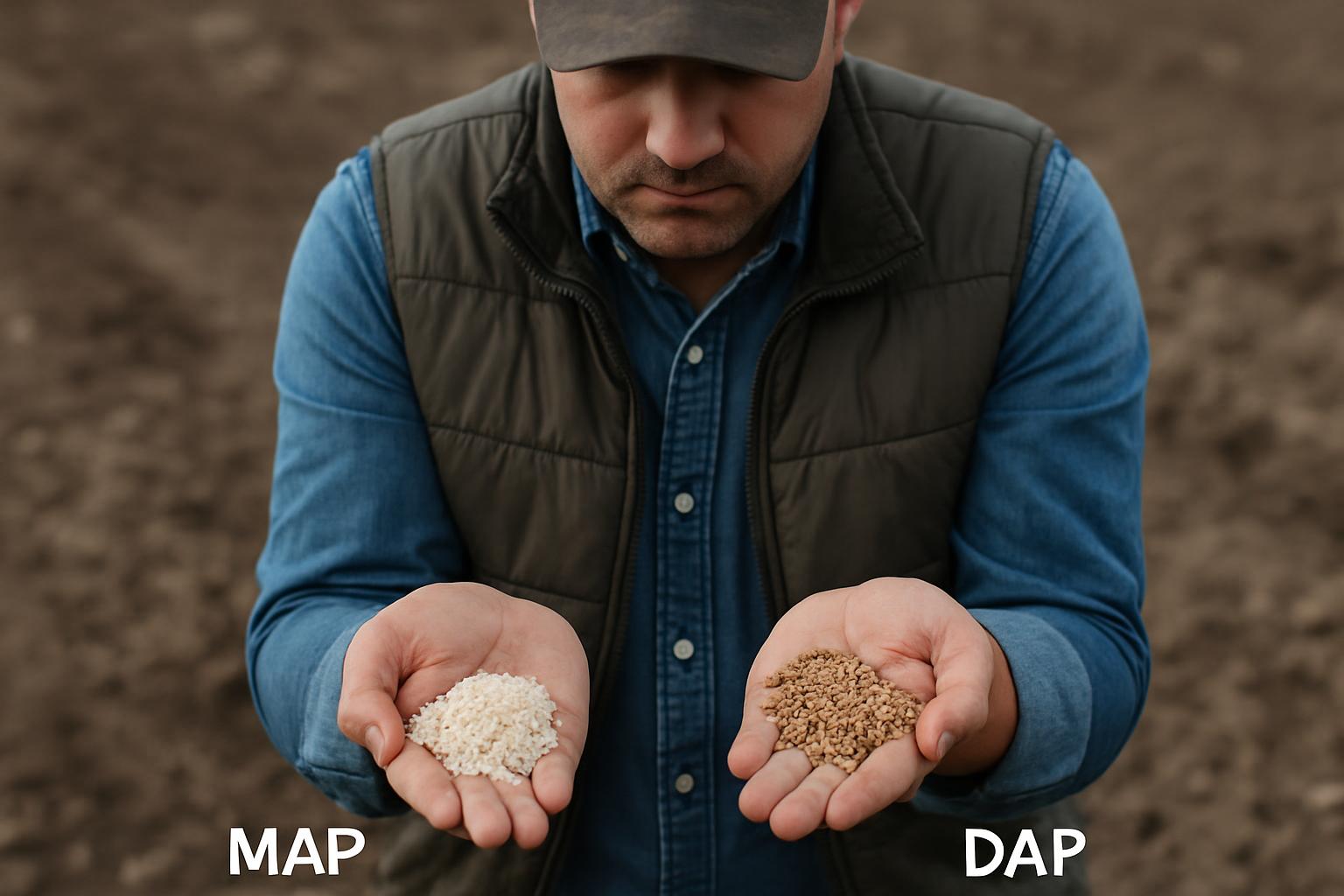
MAP vs DAP fertiliser is one of the most common comparisons when growers, resellers and agronomists plan a phosphorus program. Both products are ammonium phosphates, both are highly water soluble and both are traded in large volumes around the world, yet they behave differently at the seed, in the soil and on the cost sheet. Monoammonium phosphate (MAP) is typically 11-52-0 and acidic in solution, while diammonium phosphate (DAP) is typically 18-46-0 and mildly alkaline around the dissolving granule. This guide compares nutrients, pH, seed safety, cost per unit of phosphorus and crop fit, then finishes with clear recommendations for bulk buyers. Practices and regulations differ between countries, so always check local guidance.
In this article
- Key takeaways
- MAP vs DAP fertiliser at a glance
- What monoammonium and diammonium phosphate actually are
- How pH changes the way MAP and DAP behave
- Comparing cost per unit of phosphorus and nitrogen
- Which crops suit MAP and which suit DAP
- Soil type and regional considerations
- Blending, storage and handling
- Clear recommendations for bulk buyers
- Conclusion
Key takeaways
- MAP carries more phosphorus (about 52% P2O5) and less nitrogen (about 11% N); DAP carries more nitrogen (about 18% N) and slightly less phosphorus (about 46% P2O5).
- MAP dissolves to an acidic solution (around pH 3.5 to 4); DAP produces a temporarily alkaline zone (around pH 7.5 to 8) that can release free ammonia near seedlings.
- For seed-placed or close-to-seed crops such as canola, pulses and small seeds, MAP is usually the safer choice.
- For broadcast or pre-plant applications where extra nitrogen is useful, DAP is often the better-value choice.
- Compare products on cost per kilogram of P2O5 after crediting the nitrogen you would otherwise buy separately, not on price per tonne.
- Soil test results, soil pH and placement method should decide the product, not habit.
MAP vs DAP fertiliser at a glance
Before going into detail, it helps to see the two products side by side. The figures below are typical commercial grades; actual analyses vary by manufacturer and origin, so always read the specification supplied with each shipment.
Nutrient analysis side by side
| Property | MAP (monoammonium phosphate) | DAP (diammonium phosphate) |
|---|---|---|
| Typical grade (N-P2O5-K2O) | 11-52-0 | 18-46-0 |
| Phosphorus as P (approx.) | 22.7% | 20.1% |
| Nitrogen form | Ammonium | Ammonium |
| N to P2O5 ratio | About 1 : 4.7 | About 1 : 2.6 |
| pH of dissolving granule | Acidic, about 3.5 to 4 | Alkaline, about 7.5 to 8 |
| Best known strength | Seed safety, higher P per tonne | Higher N per tonne, widely available |
Physical and chemical properties
Both products are granular, free-flowing and compatible with most bulk handling equipment. Both are close to fully water soluble in terms of phosphorus, so the old idea that one is a faster or slower phosphate source is largely a myth. The real differences are the nitrogen share and the pH reaction at the granule, and those two factors drive almost every practical decision in the sections that follow.
What monoammonium and diammonium phosphate actually are
The names describe the chemistry. Monoammonium phosphate has one ammonium ion attached to each phosphate group, while diammonium phosphate has two. That extra ammonium is why DAP contains more nitrogen, and it also explains why DAP is more alkaline in solution.
How the two products are made
Both are produced by reacting phosphoric acid with ammonia. The degree of neutralisation determines the product: less ammonia gives MAP, more ammonia gives DAP. The phosphoric acid comes from processed phosphate rock, so impurities such as cadmium and fluorine depend on the rock source rather than on whether the final product is MAP or DAP. If cadmium limits matter in your market, ask for a certificate of analysis for the specific origin. Limits and labelling rules vary between countries.
Solubility and phosphorus availability
In both products, around 90% or more of the phosphorus is water soluble, and plants take it up as orthophosphate from the soil solution. What happens next depends on the soil: in acidic soils phosphate can bind to iron and aluminium, and in alkaline or calcareous soils it can react with calcium. These reactions affect both products in a similar way, so placement, rate and soil test levels matter far more than the choice between MAP and DAP for overall phosphorus availability.
How pH changes the way MAP and DAP behave
The pH difference is the most important practical contrast between the two fertilisers. It is a localised effect around each granule rather than a change to the whole soil, but it matters where seed and fertiliser are close together.
The pH around the granule
When a MAP granule absorbs moisture, the solution around it becomes acidic. A DAP granule creates a solution that is initially alkaline. Within days to weeks, soil buffering and nitrification reduce these differences, but the early period is when seedlings are most vulnerable.
Seedling ammonia risk
In the alkaline zone around a DAP granule, part of the ammonium converts to free ammonia gas, which is toxic to germinating seeds and young roots. The risk rises with higher rates, close seed contact, dry or coarse-textured soils, low cation exchange capacity, and sensitive crops. MAP produces much less free ammonia because the acidic reaction keeps nitrogen in the ammonium form. Maximum safe seed-placed rates depend on crop, row spacing, seedbed width and moisture, and local agronomic guidance should be followed.
Long-term soil acidification
Over seasons, ammonium nitrogen from either product is converted to nitrate by soil microbes, a process that releases hydrogen ions and acidifies soil. DAP supplies more ammonium per unit of product, but per unit of phosphorus the difference between the two is modest. In practice, total nitrogen use across the whole program has a larger effect on acidification than the MAP versus DAP decision. On soils already prone to acidity, monitor soil pH and plan liming regardless of which phosphate you use.
Comparing cost per unit of phosphorus and nitrogen
Price per tonne is a poor basis for comparison because MAP and DAP deliver different amounts of nutrients. A fair comparison converts every quote to a cost per kilogram of the nutrient you actually need.
The cost-per-unit formula
Start with the price per tonne and divide by the kilograms of P2O5 in a tonne: 520 kg for 52% MAP, 460 kg for 46% DAP. If you also need the nitrogen, subtract its value first. Effective cost of P2O5 equals the product price per tonne, minus the nitrogen supplied (kg N per tonne multiplied by your alternative cost per kg N, for example from urea), divided by the kg of P2O5 per tonne. Freight, handling and application costs should be added to both options. Our guide to DAP fertiliser price per tonne explains what drives these quotes.
A worked comparison at the same phosphorus rate
Suppose a crop needs 20 kg P2O5 per hectare (about 18 lb per acre). The table shows how much product and nitrogen each option supplies. These are calculations from typical grades, not price quotes.
| Item | MAP 11-52-0 | DAP 18-46-0 |
|---|---|---|
| Product needed for 20 kg P2O5/ha | 38.5 kg/ha (about 34 lb/ac) | 43.5 kg/ha (about 39 lb/ac) |
| Nitrogen supplied | 4.2 kg N/ha (about 3.8 lb/ac) | 7.8 kg N/ha (about 7.0 lb/ac) |
| Extra N from DAP | About 3.6 kg N/ha | |
At common phosphorus rates, the nitrogen difference is small, so DAP’s extra nitrogen rarely changes the economics dramatically. If the price gap per tonne between the two is narrow, MAP’s safety and higher phosphorus content often tip the decision. If DAP is clearly cheaper per kilogram of P2O5, it is a sound choice for crops and placements where seedling risk is low.
Which crops suit MAP and which suit DAP
Crop sensitivity, row spacing and placement method decide most of the choice. The table summarises sensible defaults, followed by notes on each situation.
| Situation | Better fit | Reason |
|---|---|---|
| Canola and other small-seeded oilseeds, seed-placed | MAP | Lower ammonia risk near sensitive seedlings |
| Pulses (chickpea, lentil, faba bean, field pea), seed-placed | MAP | Low N requirement and high sensitivity to seed-placed N |
| Cereals on wide rows or banded away from seed | MAP or DAP | Choose on cost per unit of P2O5 and N needs |
| Broadcast on pasture and hay | DAP or MAP | No seedling contact; extra N from DAP can help growth |
| Fertigation and foliar-compatible programs | Water-soluble MAP grades | Acidic reaction and fewer precipitation problems |
Seed-placed and drill-row crops
Where fertiliser sits in the seed row, choose MAP and keep within recommended rates. Canola and pulses are the clearest examples. For canola, nitrogen and sulphur planning matter as much as phosphorus; see our notes on fertiliser for canola. Cereals tolerate more, but DAP at high rates in dry seedbeds can still reduce emergence.
Broadcast pasture, hay and tree crops
When fertiliser is spread on the surface or incorporated before sowing, seedling contact is not a concern and DAP is a very reasonable option, particularly where the crop also needs nitrogen. Pasture and hay programs frequently add sulphur, which neither MAP nor DAP supplies in meaningful amounts, so check the full nutrient plan.
Fertigation and horticulture
Standard granular MAP and DAP are not designed for fertigation because of insoluble impurities. For irrigation systems, purified water-soluble monoammonium phosphate grades (often around 12-61-0) are the usual choice, partly because their acidic reaction helps keep drip systems clear in hard water. Diammonium phosphate can precipitate with calcium and magnesium in alkaline irrigation water. See our overview of water-soluble versus granular fertiliser for delivery trade-offs.
Soil type and regional considerations
Soil chemistry changes how much the granule pH matters. Reading your soil test properly is the starting point, and our guide on how to read a soil test and choose a fertiliser covers phosphorus buffering and critical levels.
Acidic soils
In acidic soils, the alkaline reaction of DAP is quickly buffered, and seedling ammonia risk is generally lower. Phosphorus fixation by iron and aluminium is the larger issue, so banding near the root zone and maintaining adequate soil pH through liming helps more than switching between MAP and DAP.
Alkaline and calcareous soils
In high-pH or calcareous soils, the soil already limits phosphorus availability through calcium reactions, and the added alkalinity from DAP can increase ammonia loss and seedling risk. MAP’s acidic microsite can modestly improve local phosphorus and micronutrient availability around the granule, which is why MAP is often preferred in these conditions. Surface-applied ammonium products on calcareous soils can also lose nitrogen as ammonia gas, so incorporate or band where possible.
Sandy and low-CEC soils
Light soils hold less ammonium and dry out quickly, which concentrates fertiliser salts and ammonia near the seed. Use MAP, lower seed-placed rates, or separate seed and fertiliser. Regulations, recommended rates and product availability differ between countries and regions, so use local extension or agronomy advice alongside this comparison.
Blending, storage and handling
Bulk buyers rarely apply MAP or DAP in isolation. They are core ingredients in blends, so compatibility and storage behaviour affect both quality and application.
Compatibility in blends
MAP and DAP both blend well with potassium sources such as muriate of potash and sulphate of potash, and with urea when particle size and humidity are managed. Matching granule size and density between components reduces segregation during loading and spreading. Nitrogen sources and moisture-sensitive materials should be checked against critical relative humidity before blending, particularly in humid climates. Our comparison of compound versus blended fertiliser explains when a blend suits and when a single-granule compound is better.
Storage and moisture
Both products absorb moisture, and DAP can release some ammonia if stored badly or heated. Keep stacks covered, off the ground, and away from direct sun, and use sealed or lined bags when storing for extended periods. For large orders, decide early whether to take delivery in bulk, bulka bags or small bags, as storage capacity should drive that choice.
Clear recommendations for bulk buyers
The right product comes down to a few practical questions about placement, crop and price per unit of nutrient.
Choose MAP when
- Fertiliser is placed in or near the seed row, especially for canola, pulses and small-seeded crops.
- Soils are sandy, dry, alkaline or calcareous.
- You want more phosphorus per tonne to reduce freight and handling per kilogram of P2O5.
- The crop does not need much extra nitrogen at sowing.
Choose DAP when
- Fertiliser is broadcast, incorporated, or banded well away from seed.
- The crop or pasture benefits from additional starter nitrogen.
- DAP is cheaper per kilogram of P2O5 after nitrogen is credited.
- Soils are moderately buffered and not prone to seedbed drying.
How to order
Match the product to your soil test and your seeding system, then request written quotes on a delivered basis for 10 to 25 tonne loads or more. Natures Fertilizer Pty Ltd supplies DAP, MAP, potassium sulphate (SOP), urea, compound and blended fertilisers, and can blend to a soil test; the process is outlined in our custom fertiliser blending worked example. For a shorter side-by-side summary, see DAP vs MAP: which phosphate fertiliser should you buy.
Conclusion
MAP and DAP are both effective, highly soluble phosphorus fertilisers, and the better choice depends on placement, crop sensitivity, soil and cost per unit of nutrient. MAP offers more phosphorus per tonne and a safer reaction near seed, while DAP offers more nitrogen and often suits broadcast programs. Compare quotes per kilogram of P2O5 with the nitrogen credited, use your soil test to set the rate, and follow local agronomic guidance for seed-placed limits.
Frequently asked questions
What is the main difference between MAP and DAP fertiliser?
MAP (typically 11-52-0) has more phosphorus and less nitrogen than DAP (typically 18-46-0). MAP is acidic around the granule, while DAP is temporarily alkaline. This pH difference affects seedling safety and ammonia loss.
Is MAP or DAP better for canola?
MAP is usually preferred where fertiliser is placed with or near canola seed, because it creates less free ammonia and is gentler on small seedlings. DAP can be used if banded away from the seed or broadcast before sowing. Always follow local guidance for maximum seed-placed rates.
Is DAP or MAP more acidifying?
Both acidify soil over time as ammonium is converted to nitrate. DAP supplies more nitrogen per tonne, but per unit of phosphorus the difference is small. Total nitrogen use across your program has a greater effect on soil acidity.
Which is cheaper, MAP or DAP?
It depends on market prices and freight, which change often. Compare cost per kilogram of P2O5 (520 kg per tonne for MAP, 460 kg for DAP) and credit the nitrogen value. Price per tonne alone is misleading.
Can I use MAP or DAP in fertigation systems?
Standard granular products usually contain insoluble impurities that can block emitters. Use purified water-soluble monoammonium phosphate grades for fertigation. DAP can precipitate with calcium and magnesium in hard or alkaline water.
Do MAP and DAP contain sulphur or potassium?
Standard MAP and DAP contain little or no potassium, and only small amounts of sulphur. Crops with sulphur or potassium needs, such as canola or pasture, may need additional products like sulphate of potash or ammonium sulphate.
Does the phosphorus in DAP work faster than MAP?
No. Phosphorus in both products is highly water soluble and available to plants at similar speeds. Soil conditions, placement and rate have more influence on uptake than product choice.
Leave a Reply