
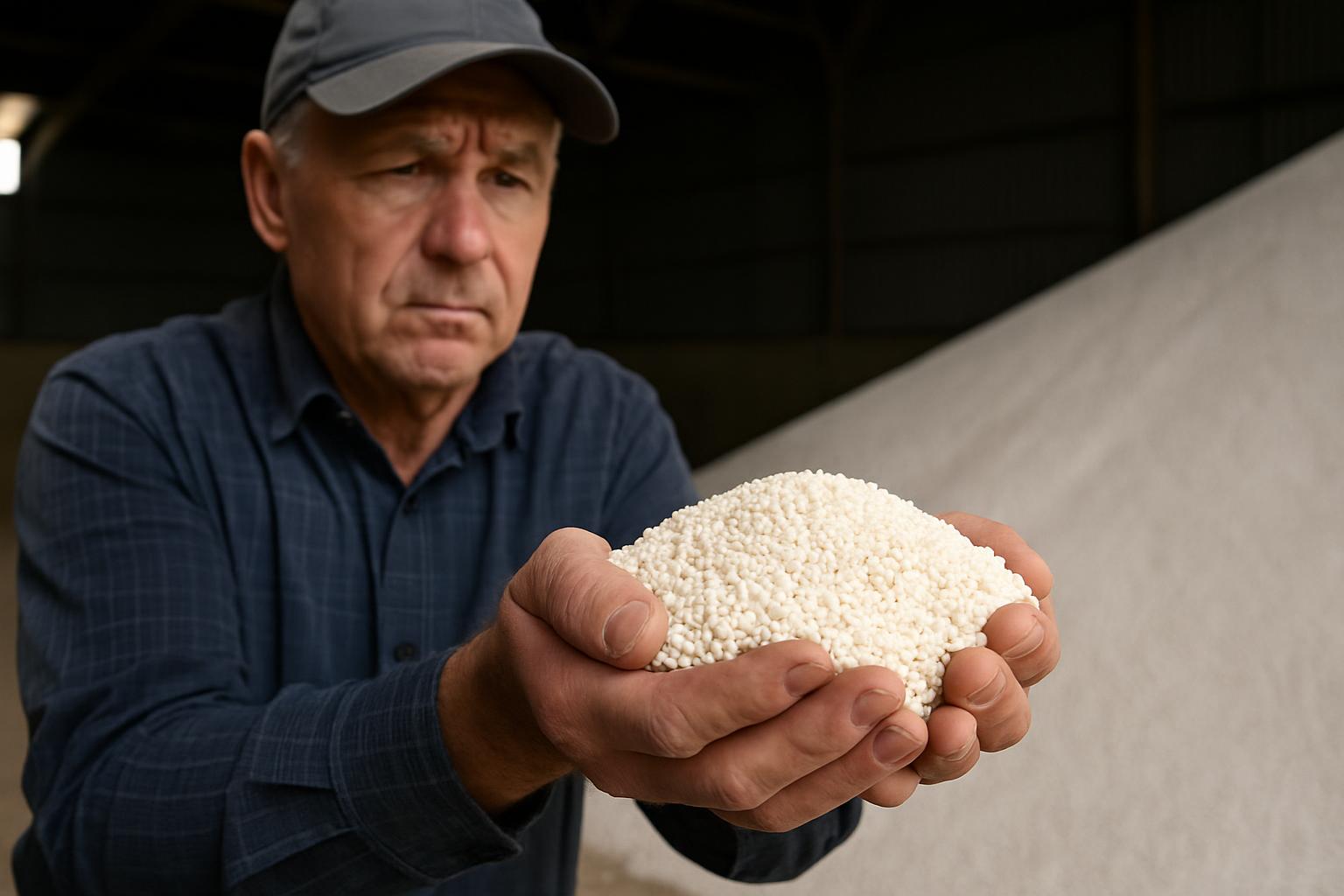
If you are searching for the DAP fertiliser price per tonne, you have probably noticed that two quotes for the same product can look very different, and that a single number rarely tells you much on its own. Diammonium phosphate (DAP, usually 18-46-0) is traded across the world, so its price reflects phosphate rock, ammonia, sulphur, freight, currencies and the shape of your own order. This guide explains what sits inside a per-tonne figure, why it moves, and how to compare offers on equal terms. We do not publish prices here because they change constantly and depend on delivery point, volume and timing. Instead, you get a method you can apply to any DAP quote, anywhere.
In this article
- Key takeaways
- What a DAP fertiliser price per tonne really includes
- Global market forces behind the DAP price
- Freight, ports and inland delivery
- Exchange rates and payment terms
- How order size and packaging change the per-tonne figure
- How to compare DAP quotes fairly
- Beyond price per tonne: DAP fertiliser cost per unit of nutrient
- Timing your purchase and managing price risk
- Conclusion
Key takeaways
- A DAP price per tonne is only meaningful when you know the price basis (ex-works, FOB, CFR or delivered), the tonne definition and the payment terms.
- Global inputs such as phosphate rock, ammonia, sulphur and major-buyer demand set the baseline; freight, exchange rates and order size decide the figure on your quote.
- Compare quotes on a delivered, like-for-like basis, including product specification, packaging, timing and validity.
- Cost per kilogram of nutrient is a better yardstick than cost per tonne, especially when comparing DAP with MAP or a blend.
- Early planning and a written, individually quoted order usually give more certainty than chasing the market day by day.
What a DAP fertiliser price per tonne really includes
A quoted figure is a bundle of costs and conditions. Before you judge whether it is high or low, you need to know exactly what has been bundled into it.
Price basis: ex-works, FOB, CFR or delivered
International trade uses standard terms. FOB (free on board) means the seller covers cost up to loading the vessel. CFR and CIF add ocean freight (and, for CIF, insurance) to a named destination port. Ex-works or ex-store means you collect from a warehouse. A delivered price includes transport to your farm or depot. The same product can look much cheaper on an FOB basis than delivered, simply because the freight is missing. Note that the Incoterms rule called DAP (Delivered at Place) shares an acronym with the fertiliser, which causes real confusion in trade emails, so always spell out which one you mean.
Which tonne are you buying?
Most of the world trades in metric tonnes (1,000 kg, about 2,205 lb). Some markets still quote per short ton (2,000 lb, about 907 kg), so a figure per short ton and a figure per metric tonne are not directly comparable. Confirm the unit before you compare anything.
Product specification and analysis
DAP is commonly sold as 18-46-0 (18% nitrogen, 46% P2O5), but real-world product can vary in nutrient content, granule size, moisture and origin. A cheaper offer may carry a slightly lower analysis or different physical quality. Ask for the guaranteed analysis in writing, because that is what you are really paying for.
Global market forces behind the DAP price
DAP is a global commodity, so the DAP price in any one country sits on top of an international benchmark. Understanding what moves that benchmark helps you read the market rather than react to it.
Raw materials: phosphate rock, ammonia and sulphur
Producers make DAP by reacting phosphoric acid with ammonia. Phosphoric acid in turn comes from phosphate rock treated with sulphuric acid, which is made from sulphur. That means three raw material streams feed one product. Phosphate rock is concentrated in a limited number of producing countries, while ammonia is tied to natural gas and energy costs, and sulphur is often a by-product of oil and gas refining. A change in any of these can shift the cost of making DAP.
Demand cycles and export policy
Large importing regions, seasonal buying windows and crop prices all influence demand. When growers in major farming regions buy at the same time, availability tightens and prices tend to firm. On the supply side, export quotas, taxes or restrictions imposed by producing countries can quickly change what is available to the world market. These policy decisions are difficult to predict and are one reason prices can move even when production costs are stable.
Why fertiliser prices tend to move together
Nitrogen, phosphate and potash prices are not identical, but they share drivers: energy costs, freight, grain prices, currency movements and farmer affordability. If you want a broader look at these linked factors, see our overview of what drives a fertiliser quote. The practical lesson is that DAP rarely moves in isolation, so watching related markets can give early hints about direction.
Freight, ports and inland delivery
For imported fertiliser, logistics can account for a meaningful share of the delivered cost. Unlike the benchmark price, freight is highly specific to your location and order.
Ocean freight and fuel
Shipping rates depend on vessel availability, fuel costs, route distance and how busy the trade lane is. Bulk cargoes, container shipments and part-cargoes each have different cost structures. Buyers who receive product in containers, for example export customers, face container availability and rate swings that bulk buyers may not. Where relevant, our guide to exporting fertiliser from Australia explains how containers and payment terms affect an offer.
Port handling and storage
Fertiliser landed at a port incurs unloading, storage and handling costs before it moves anywhere. Ports differ in their equipment, congestion and charges, and the choice of load-out port can change the final figure. Product that has to wait in storage for a few weeks costs more to hold than product moved quickly.
Inland haulage to the farm gate
Distance matters, and so does access. A delivery to a regional depot near a port will usually cost less per tonne than a delivery to a remote property, particularly where roads, truck configurations or unloading conditions are restrictive. Ask whether the quote assumes a full truck load, whether unloading equipment is needed, and who is responsible for waiting time or failed deliveries. These details are easy to overlook and can quietly add to the final cost.
Exchange rates and payment terms
Currency is often the least visible driver of the DAP fertiliser cost, yet it can matter as much as the commodity price itself.
Dollar-linked pricing and your local currency
Internationally, fertiliser is typically priced in US dollars. If you pay in another currency, the exchange rate between the two feeds directly into your price. A stronger local currency makes imports cheaper, and a weaker one makes them more expensive, even if the dollar price of DAP has not changed. When you compare a quote now with one from a few weeks ago, check whether any change came from the commodity price, the exchange rate, or both. Ask the supplier which exchange rate assumption underlies the quote, and whether it is fixed or will move before invoicing.
Payment terms and quote validity
Prompt payment, deposits, trade credit and letters of credit all carry different costs for the seller, and these are often reflected in the price. Offers on extended terms may carry a premium compared with cash or advance payment. Equally important is quote validity: a figure that expires in a few days offers less certainty than one held for a longer period. Always compare validity windows alongside the price, because the cheapest offer is not helpful if it lapses before you can decide.
How order size and packaging change the per-tonne figure
Order size affects almost every cost line from loading to unloading. Suppliers who serve wholesale buyers, as we do at Natures Fertilizer Pty Ltd with orders typically from 10 to 25 MT upwards, price on this basis because larger, simpler loads are cheaper to handle.
Load size and logistics efficiency
A full truck, a full container or a full vessel parcel spreads fixed costs, such as paperwork, loading and driver time, across more tonnes. Part loads, mixed loads and multi-drop deliveries each add complexity, so the per-tonne cost usually rises as the order becomes smaller or more fragmented. Ask suppliers where their quantity break points sit, because ordering slightly more to reach a full load can sometimes reduce the cost per tonne.
Bulk, bulka bag or bagged
Loose bulk is generally the least expensive to handle, but it needs suitable storage and spreading equipment. Bulka bags (large bags, often around one tonne) suit buyers who want flexibility, while small bags cost more to fill and handle but suit smaller storage or resale. Our guide to how to take delivery in bulk, bulka bags or bagged form sets out the trade-offs in more detail.
Splitting deliveries across the season
Taking everything at once is usually cheaper to move, but it requires storage and capital. Staged deliveries reduce storage needs and can match cash flow, though each drop adds cost and exposes later tranches to price changes. Decide which matters more for your operation, then ask the supplier to quote both options in writing so you can compare them directly.
How to compare DAP quotes fairly
Comparing quotes is mostly a matter of removing differences until only the price remains. The table below summarises what to check.
A side-by-side checklist
| Item to check | Why it matters | Question to ask |
|---|---|---|
| Price basis | FOB, CFR and delivered figures are not comparable | Does this include freight and delivery to my site? |
| Tonne unit | Metric tonne and short ton differ by about 10% | Is this per metric tonne? |
| Analysis | Lower nutrient content means less value per tonne | What is the guaranteed N and P2O5? |
| Packaging | Bulk, bulka and bagged have different handling costs | How will it be delivered and unloaded? |
| Taxes and charges | Some quotes exclude taxes, levies or fuel surcharges | Is the price inclusive or exclusive of taxes? |
| Timing | Delivery windows affect your planting or application | When will it arrive, and is that guaranteed? |
| Validity and terms | Short validity or strict payment terms add risk | How long is the quote held, and what are payment terms? |
A simple step-by-step process
- Ask each supplier to quote the same quantity, product, packaging and delivery point.
- Convert every price to the same currency, unit (metric tonne) and basis (delivered).
- Confirm the guaranteed analysis and any tolerance in writing.
- Note validity, payment terms and any conditions about access or unloading.
- Calculate cost per kilogram of nutrient, not just per tonne.
- Weigh reliability, communication and documentation alongside price.
For a wider supplier-selection framework, our guide to buying DAP in Australia covers supply and delivery points to raise before you commit.
Beyond price per tonne: DAP fertiliser cost per unit of nutrient
Price per tonne is convenient, but what you actually buy is nutrient. Two products at different prices per tonne may deliver nutrients at a very similar cost, or at very different ones.
Calculating cost per kilogram of phosphorus
A simple method: divide the price per tonne by 1,000 to get the price per kilogram of product, then divide by the nutrient fraction. For DAP with 46% P2O5, divide by 0.46 to estimate cost per kilogram of P2O5. DAP also supplies about 18% nitrogen, so some buyers credit part of the cost against the nitrogen they would otherwise buy as urea. Whether you apply a credit depends on whether you need that nitrogen at that stage of the crop, so treat it as a judgement, not an automatic discount. Phosphorus is also sometimes expressed as elemental P rather than P2O5, so confirm which basis any comparison uses.
DAP, MAP and custom blends
Monoammonium phosphate (MAP) has a different nutrient ratio and may suit certain soils and crops better, or cost less per unit of phosphorus depending on the market. Our comparison of DAP vs MAP explains when each makes sense. In some cases, a blended or compound product matched to a soil test supplies the right balance of nitrogen, phosphorus, potassium and sulphur in one pass, avoiding the cost of buying and applying several straight products. A soil test is the right starting point, and we blend to match one, but the cheapest product per tonne is not always the cheapest solution per hectare or acre.
Timing your purchase and managing price risk
No one can reliably predict short-term fertiliser prices, so the goal is not to time the market perfectly. It is to avoid being forced to buy at the worst moment.
Planning ahead of the season
Demand peaks around planting and application windows in each region, and suppliers, ports and trucks all get busier. Requesting quotes well before you need product gives you time to compare, adjust quantities and arrange storage. Northern and southern hemisphere seasons differ, which means global demand is spread across the year, but local peaks still apply wherever you farm.
Locking in what you can
Where a supplier offers a written quote with a defined validity and delivery window, accepting it removes uncertainty about price and availability. Consider the following when planning:
- Estimate your phosphorus requirement from a soil test before asking for quotes.
- Decide whether you can store product, or need staged deliveries.
- Ask for quotes at two or three quantities to see where price breaks fall.
- Keep records of past quotes and what drove changes between them.
Natures Fertilizer Pty Ltd quotes each order individually in writing, supplying DAP, MAP, potassium sulphate (SOP), compound and blended products, with custom blending matched to your soil test. Terms, availability and regulations vary between countries and regions, so check local requirements for import, storage and application before you finalise an order.
Conclusion
The DAP fertiliser price per tonne is the end product of global raw material costs, demand and policy, then freight, exchange rates, payment terms and the size and shape of your order. To judge any quote fairly, align the price basis, tonne unit, analysis, packaging, timing and validity, then compare cost per unit of nutrient rather than per tonne alone. With early planning and clear written quotes, you can make a confident decision whatever the market is doing.
Frequently asked questions
What is a typical DAP fertiliser price per tonne?
There is no single figure, because the price depends on the benchmark market, price basis, freight, exchange rates, order size and timing. A quote only makes sense when you know whether it is FOB, CFR or delivered and in which currency. The most reliable approach is to request written quotes for your specific quantity and delivery point.
Why does the DAP price change so often?
DAP is traded globally, so it responds to phosphate rock, ammonia and sulphur costs, demand from large importing regions, export policies and freight. Currency movements also change the local price even when the dollar price is stable. Short-term swings are common, which is why quote validity matters.
Is DAP cheaper if I buy in bulk?
Usually the cost per tonne falls as loads become larger and simpler to handle, because fixed costs are spread across more product. Full truck loads, containers or vessel parcels are generally more efficient than part loads. Ask suppliers where their quantity break points fall.
How do I compare DAP quotes from different suppliers?
Make sure each quote uses the same price basis, metric tonne unit, currency, analysis, packaging and delivery point. Then check payment terms and validity. Finally, convert prices to cost per kilogram of nutrient so you can compare products with different analyses.
What is the difference between DAP and MAP pricing?
DAP is about 18-46-0 and MAP is about 11-52-0 (analyses vary slightly by producer), so they supply different amounts of nitrogen and phosphorus per tonne. Their prices move with different supply and demand conditions. Compare them on cost per unit of phosphorus and consider the nitrogen you need.
Do exchange rates really affect the DAP fertiliser cost?
Yes. Because fertiliser is generally priced internationally in US dollars, a weaker local currency raises the local price and a stronger one lowers it. Ask whether your quote fixes an exchange rate or will change before invoicing.
Can a soil test lower my fertiliser spend?
A soil test shows which nutrients are actually needed, which helps you avoid paying for nutrients you do not require. It can also reveal when a blended or custom product suits better than straight DAP. The result depends on your soil, crop and local conditions.
Leave a Reply