
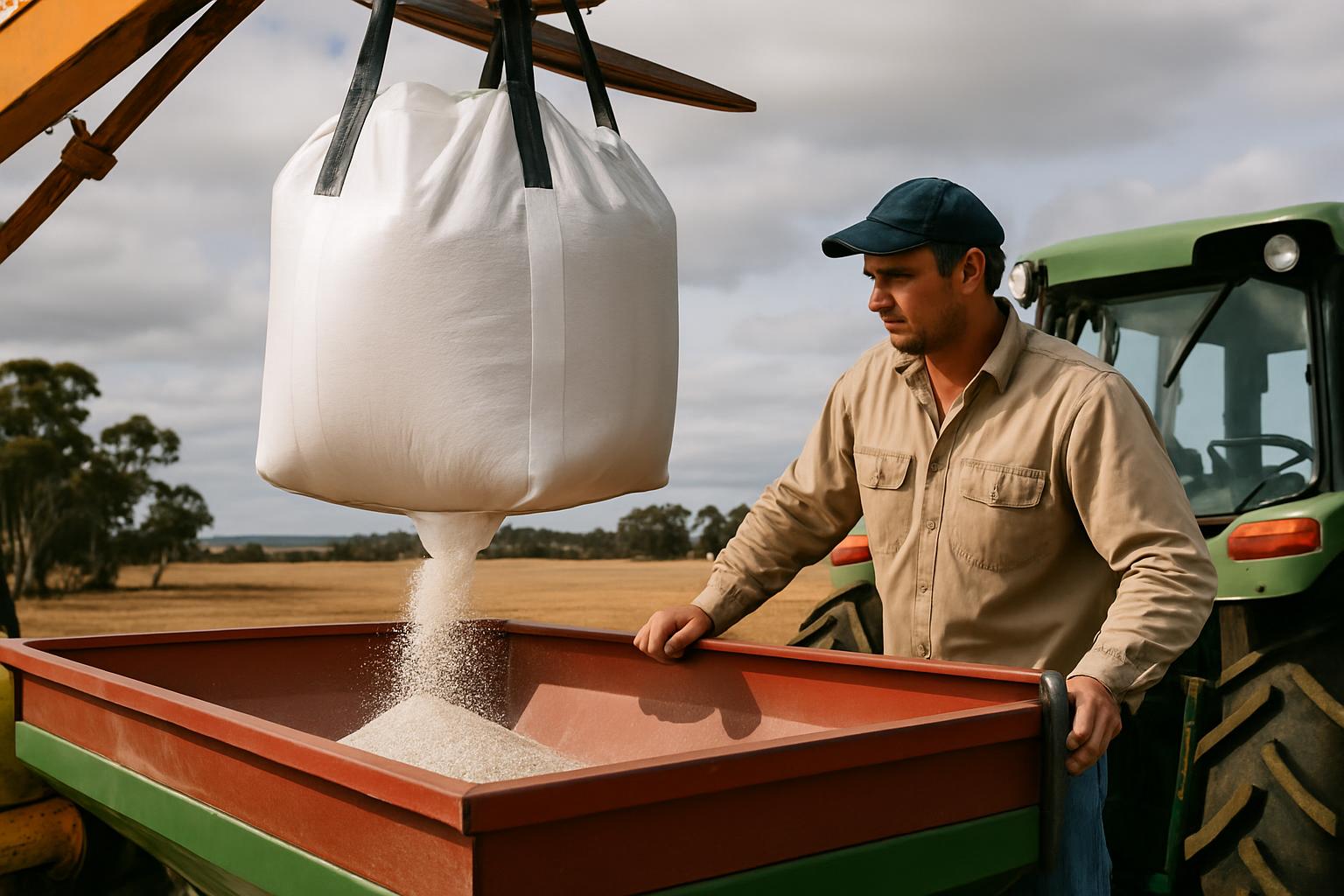
Choosing a bulk fertiliser supplier Australia growers can rely on is less about the lowest headline number and more about whether the product, paperwork and delivery match what your soil and crop actually need. When you buy in loads of 10 to 25 MT or more (roughly 11 to 28 short tons), a mistake in grade, timing or freight is expensive to fix. This guide is a practical checklist for farms, resellers, agronomy businesses and export buyers. It covers grade guarantees, soil-test matching, minimum orders, freight and written quotes, the details many supplier pages skip. Use it to compare suppliers on equal terms, whether you buy within Australia or have product shipped overseas.
In this article
- Key takeaways
- What a bulk fertiliser supplier in Australia actually does
- Checklist item 1: grade guarantees and analysis
- Checklist item 2: soil-test matching and custom blending
- Checklist item 3: minimum order and packaging
- Checklist item 4: freight and bulk fertiliser delivery
- Checklist item 5: what a written quote should include
- Products to ask your supplier about
- Red flags and final questions before you buy
- Conclusion
Key takeaways
- Ask for a written grade guarantee that states every nutrient, its form and the source, not just an NPK label.
- Match the product to a recent soil test and crop plan before you ask for a price, so quotes are comparable.
- Confirm the minimum order and the packaging format early, because they change both freight cost and handling.
- Check freight terms line by line: who pays, who unloads, and what happens if delivery is delayed or refused.
- Insist on an individual written quote that states quantity, grade, packaging, delivery terms and validity period.
- Regulations, labelling and import rules differ between countries, so export buyers should verify destination requirements first.
What a bulk fertiliser supplier in Australia actually does
The terms blender, manufacturer, distributor and wholesaler are used loosely, and the differences matter when something goes wrong. Knowing which role your supplier plays tells you who controls quality, who holds stock and who carries the risk if a batch is off specification.
Blender, compound producer or trader
A blender mixes granular straight fertilisers, such as urea, DAP, MAP and potassium sulphate, to reach a target analysis. A compound fertiliser producer makes granules in which each particle carries several nutrients. A trader or distributor buys finished product and arranges storage and delivery. Many businesses combine these roles, so ask directly: which products do you blend, which do you source in finished form, and who is responsible for the analysis on the final load?
Who typically buys fertiliser in bulk
Bulk buyers include broadacre and horticulture farms, pasture and hay producers, fertiliser resellers, agronomy businesses and export customers. A reseller needs consistent bagged stock and clear labelling for onward sale. A grower needs a blend that fits a paddock program. An export buyer needs documentation and container loading. A good supplier asks which of these you are, because the right answer to almost every other question depends on it.
Checklist item 1: grade guarantees and analysis
A grade such as 15-5-12 is only a starting point. Two products with the same headline numbers can behave very differently in the field, so the guarantee behind the numbers is what you are really buying.
What a grade guarantee should state
Ask for the guarantee in writing before you commit. At minimum it should cover:
- The percentage of each declared nutrient: nitrogen (N), phosphorus (P), potassium (K), sulphur (S) and any trace elements.
- The form of nitrogen, for example urea, ammoniacal or nitrate, because this affects losses and speed of response.
- The phosphorus source and its solubility, since the declared figure is not always equally available to the crop.
- The potassium source, particularly whether it is chloride-based or sulphate-based (see our comparison of SOP and MOP).
- Physical specification such as granule size range and moisture, which affect spreader performance and storage.
Compound versus blended: what changes in the guarantee
With a compound granule, every particle carries the declared ratio, so spreading is even by design. With a blend, the declared analysis is the average of several components, which makes granule size matching important to avoid separation in transport and spreading. Neither is better in every case. The right choice depends on your crop, equipment and the nutrients you need. Whichever you choose, ask the supplier to explain how the declared analysis is verified and whether a batch analysis is available on request. Regulations on labelling and tolerances vary by country and, within Australia, by state, so check what applies where the product will be sold or used.
Checklist item 2: soil-test matching and custom blending
The most useful question a supplier can ask you is what your soil test says. Fertiliser chosen from a soil test targets what the soil lacks, rather than repeating last season’s habit.
What to send your supplier
Provide a recent soil test report from an accredited laboratory, the crop and expected yield, and the paddock size. Include pH, organic matter, available phosphorus and potassium, sulphur, and any trace element results. If you are unsure how to interpret the report, our guide on how to read a soil test and choose a fertiliser walks through the main readings. Note that laboratories use different extraction methods and units (mg/kg versus ppm, kg/ha versus lb/acre), so state which method your report uses.
Turning a soil test into a blend
A supplier that offers custom blending can build an analysis around the gaps in your test rather than selling a fixed grade. The process usually runs: soil test, agronomist recommendation, target analysis, component selection, written quote. See how to order a custom fertiliser blend to a soil test for the steps in detail. A blend should always be confirmed by your own agronomist, because rates depend on crop, rainfall, soil type and local practice. Natures Fertilizer Pty Ltd blends to a customer’s soil test and quotes each order individually in writing.
Checklist item 3: minimum order and packaging
Minimum order rules protect the supplier’s blending and freight efficiency, but they differ widely between businesses. Knowing yours early prevents surprises at the quote stage.
Typical minimum quantities
Wholesale fertiliser is commonly sold from around 10 MT upward, with 25 MT or more being typical for full truck or container loads. One metric tonne is 1,000 kg, or about 2,205 lb. Ask whether the minimum applies per product or per order, and whether mixed-product loads are allowed. Custom blends often carry a higher minimum than catalogue grades because a blending run must be set up for each analysis.
Bulk, bulka bag or bagged
Packaging affects your handling equipment, storage space and unit cost. Loose bulk is usually cheapest per tonne but needs a tipping area and covered storage. Bulka bags, typically around 500 to 1,000 kg, suit sites with a forklift or loader. Smaller bags suit resellers and retail repacking. Our guide to taking delivery in bulk, bulka bags or bags compares the options. Confirm the exact bag weight, since 25 kg, 40 kg and 50 kg bags all exist and change pallet counts and container loads.
Checklist item 4: freight and bulk fertiliser delivery
Freight often accounts for a large share of the delivered cost in a country as large as Australia, so treat it as a core part of the decision, not an afterthought.
Domestic delivery questions
Ask these before accepting a delivered price:
- Is the price ex-works, free on truck or delivered to your farm gate?
- Is there access for the delivery vehicle, and who is responsible if the truck cannot reach the storage point?
- Who unloads, and is there a waiting-time charge?
- What is the delivery window, and how much notice will you receive?
Vehicle payloads depend on the truck configuration and local road rules, so a load of 20 to 40 MT is common but not guaranteed. Remote sites may add cost or time, especially in the wet season when roads can close.
Export shipments and containers
Export orders add container loading, documentation and payment terms. A 20-foot container commonly carries somewhere around 20 to 26 MT of bagged fertiliser, depending on product density and bag type. Confirm the incoterm, port of loading, expected transit time and the documents supplied. Import rules, labelling requirements and restrictions on certain fertilisers, particularly high-nitrogen products, vary by country, so check destination requirements before you order. Our article on exporting fertiliser from Australia, containers and T/T payment covers the practical steps.
Timing and storage on arrival
Plan delivery ahead of the application window, not on the day you need product. Store fertiliser dry, off the ground and away from moisture, because many products absorb water and cake. Keep different products separated and clearly labelled, and never store urea-based products near seed or chemicals.
Checklist item 5: what a written quote should include
A verbal price is not a quote. A written quote lets you compare suppliers like for like and gives you a record if the delivered product differs from what you agreed.
Quote line items compared
| Quote item | What to look for | Why it matters |
|---|---|---|
| Product and grade | Full analysis with nutrient forms | Prevents substitution of a cheaper source |
| Quantity | Tonnage and tolerance, in MT | Avoids disputes on short or over delivery |
| Packaging | Bulk, bulka or bag weight | Affects handling and unit cost |
| Delivery terms | Ex-works, delivered or incoterm | Shows who pays and who carries risk |
| Delivery window | Dates or lead time | Aligns supply with application timing |
| Payment terms | Deposit, due date, method | Clarifies cash flow and obligations |
| Validity | Date the price expires | Raw material and freight costs move |
Comparing quotes fairly
Compare the delivered cost per tonne of the nutrient you need, not just the price per tonne of product. A higher-analysis product can cost more per tonne yet less per kilogram of nutrient. Ask the supplier to quote on the same grade, volume and delivery point so the figures are comparable. Because costs shift with global markets, quotes carry an expiry date, and good suppliers are willing to explain what drives their number.
Products to ask your supplier about
A broad range lets a supplier recommend what fits your program rather than what is on the shelf. It is reasonable to ask what the supplier can provide from a single source, because consolidating loads can reduce freight handling.
Granular and compound lines
Natures Fertilizer Pty Ltd supplies compound NPK fertiliser, high tower compound fertiliser, blended fertiliser, urea 46-0-0, DAP, MAP and potassium sulphate (SOP). Straight products suit programs where you want to control each nutrient separately, while compounds suit simpler, uniform applications. If you are weighing options for a particular crop, the guide to compound versus blended fertiliser sets out the trade-offs. For a full list of lines, see the product catalogue.
Specialty and organic lines
Water-soluble fertiliser suits fertigation and foliar programs, where solubility and low insoluble residue matter. Organic and biological organic fertilisers can support soil organic matter and biology, though they are usually lower in nutrient concentration, so rates and freight per unit of nutrient differ from synthetic products. Ask for the nutrient analysis and the carbon or organic matter content, and treat any claim without supporting data with caution.
Red flags and final questions before you buy
Most supply problems are visible before the order if you know what to look for. Work through these questions with every supplier on your shortlist:
- Can you provide the grade guarantee and nutrient forms in writing before I order?
- Will you match the product to my soil test, and who checks the recommendation?
- What is the minimum order for this product, and does it change for a custom blend?
- What packaging is available, and what is the exact bag or bulka weight?
- Is the quoted price delivered, and what additional costs could apply?
- What is the lead time, and what happens if delivery is delayed?
- How long is the quote valid, and what causes the price to change?
- If the product does not match the agreed analysis, what is the process to resolve it?
Be wary of a supplier who will not put a guarantee or quote in writing, who pushes a fixed product without asking about your soil or crop, who quotes a single per-tonne figure without stating delivery terms, or who cannot say where the product is blended or stored. Vague answers at the quote stage rarely become clearer after delivery.
Conclusion
Choosing a bulk fertiliser supplier comes down to clear, written answers on grade, soil-test fit, minimum order, freight and quote terms. Suppliers that welcome these questions are usually the ones that deliver what they agreed. Use the checklist above to compare options on the same basis, confirm the recommendation with your agronomist, and check local or destination regulations before you commit to a load.
Frequently asked questions
What is the minimum order for bulk fertiliser in Australia?
It varies by supplier and product. Wholesale orders commonly start around 10 MT, with 25 MT or more typical for full truck or container loads. Custom blends may carry a higher minimum, so confirm it before requesting a quote.
How do I choose a bulk fertiliser supplier?
Compare suppliers on written grade guarantees, willingness to match a soil test, minimum order, freight terms and quote clarity. Ask for the same grade, quantity and delivery point from each so prices can be compared fairly.
Is it cheaper to buy fertiliser in bulk?
Often the cost per tonne falls with larger volumes and loose bulk packaging, but freight, storage and handling can offset the saving. Compare the delivered cost per kilogram of nutrient rather than the price per tonne of product.
What should a fertiliser written quote include?
It should state the product and full analysis, quantity, packaging, delivery terms, delivery window, payment terms and the date the price expires. Without these details, you cannot compare quotes reliably or resolve disputes.
Can a supplier blend fertiliser to my soil test?
Some suppliers offer custom blending based on a soil test and crop plan. Provide a recent laboratory report and your crop details, and have your agronomist confirm the recommended analysis and rates.
Do Australian suppliers export fertiliser overseas?
Yes, some Australian blenders and distributors ship to export customers in containers. Confirm the incoterm, port, documents and payment terms, and check the import and labelling rules of the destination country before ordering.
How much fertiliser fits in a shipping container?
A 20-foot container commonly carries around 20 to 26 MT of bagged fertiliser, depending on product density and bag type. Ask your supplier for the exact loading figure for your product.
What is the difference between a compound and a blended fertiliser?
A compound fertiliser has several nutrients in each granule, so every particle has the same ratio. A blend mixes separate granular components to reach a target analysis, which allows more flexibility but needs well-matched granule sizes.
Leave a Reply