
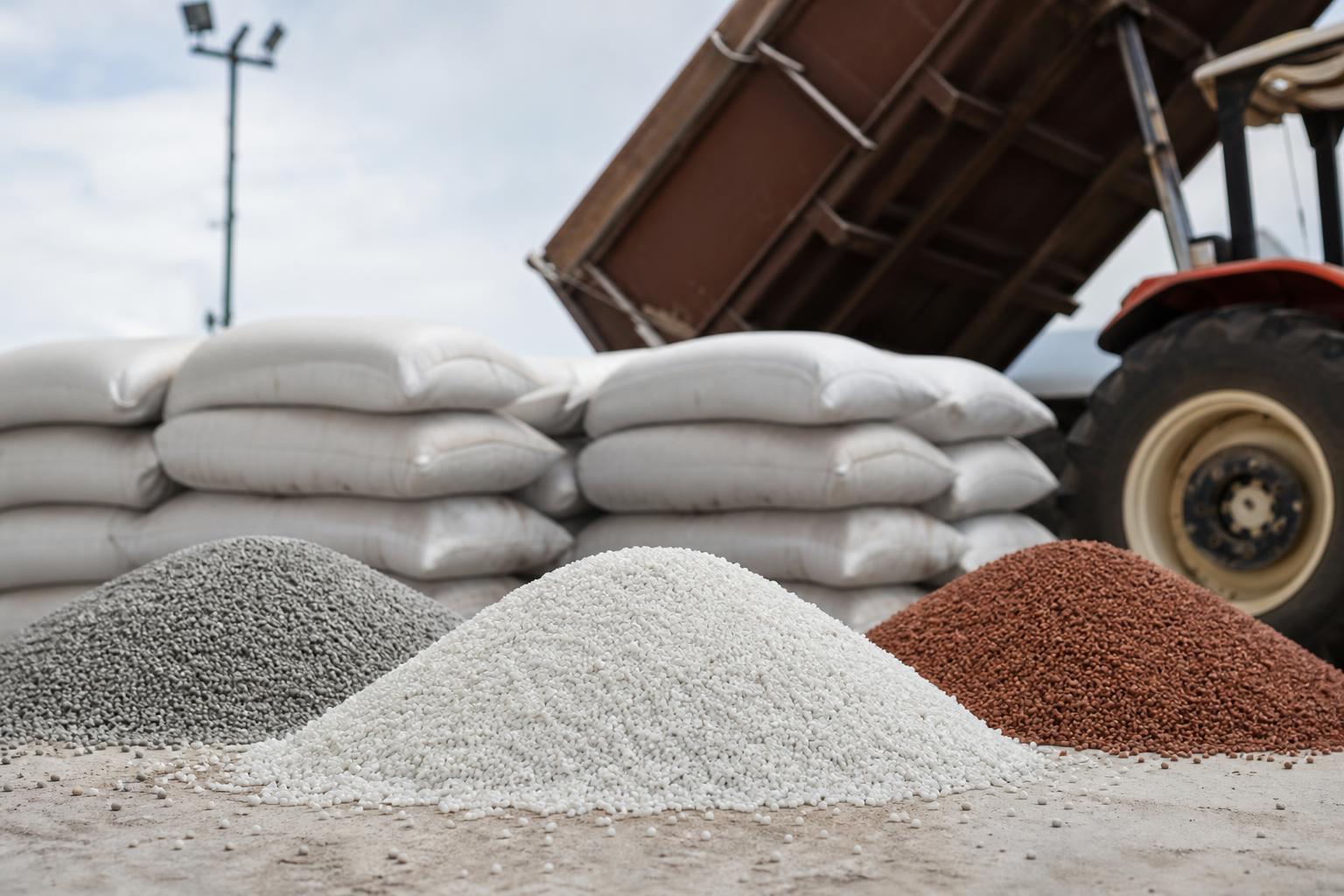
Understanding NPK fertiliser price per tonne is the first step to comparing bulk quotes fairly, but the number on its own tells you very little. A tonne of 20-10-10 and a tonne of 10-10-10 are both “a tonne of NPK”, yet one carries 400 kg of nutrients and the other 300 kg. Add differences in granule type, packaging and freight, and two quotes that look close can differ widely in what it costs to put a kilogram of nitrogen, phosphorus or potassium into the soil. This guide explains what shapes an NPK quote, how to read the grade, and how to calculate cost per unit of nutrient, so growers, resellers and agronomy buyers in any country can compare like with like.
In this article
- Key takeaways
- What goes into an NPK fertiliser price per tonne
- Reading the grade: nutrient concentration per tonne
- Granule type: compound, high tower, blended and water-soluble
- Freight and delivery: the part of the quote people overlook
- How to calculate NPK cost per tonne of nutrient
- Compound, blended or straight fertilisers: which gives the lower cost per unit?
- How to request a quote you can actually compare
- Common mistakes when comparing NPK quotes
- Conclusion
Key takeaways
- A price per tonne is only comparable between products of the same grade, granule type, packaging and delivery basis.
- Nutrient concentration is the biggest lever: a higher-analysis grade delivers more nutrient in every tonne you pay to make, ship and spread.
- Divide the quoted price by the kilograms of nutrient per tonne, and only count the nutrients your soil test says the crop needs.
- Freight, packaging and the delivery basis can change the landed cost of a tonne as much as the product itself.
- Bulk NPK is quoted in commercial quantities, so ask for a written, itemised quote and a Certificate of Analysis to confirm what is in the product.
What goes into an NPK fertiliser price per tonne
An NPK quote is built from several layers. Understanding them helps you see why two suppliers can quote differently for what looks like the same grade.
Raw materials and nutrient sources
NPK fertiliser is made from nitrogen, phosphate and potash ingredients. Nitrogen typically comes from urea or ammonium compounds, phosphate from ammonium phosphates such as DAP or MAP, and potassium from muriate of potash (MOP) or sulphate of potash (SOP). These materials are traded internationally, so their costs move with global energy markets, freight rates and supply conditions. The ingredient choice matters: a grade made with SOP rather than MOP carries sulphur and is low in chloride, which suits sensitive crops but is built from a different raw material.
Manufacturing route and grade
How the product is made also affects the quote. Chemical granulation, prilling in a tower and dry blending of separate granules each have different processing steps and equipment. Higher-analysis grades use fewer fillers, so more of each tonne is active nutrient. Lower-analysis grades contain more carrier material, which you pay to transport and spread.
Currency, timing and volume
Quotes reflect exchange rates, ingredient costs on the day, order size and the destination. This is why Natures Fertilizer Pty Ltd does not publish list prices: every enquiry receives an individual written quote, and lead time is confirmed in that quotation. For more on what moves a quote, see fertiliser prices in Australia and what drives your quote.
Reading the grade: nutrient concentration per tonne
The grade is the foundation of any cost comparison. It tells you how much nutrient you receive for each tonne purchased.
What the three numbers mean
The three numbers are the percentage by weight of nitrogen (N), phosphate (P2O5) and potash (K2O). A 20-10-10 product is 20% N, 10% P2O5 and 10% K2O. One tonne is 1,000 kg (about 2,205 lb), so 20-10-10 contains 200 kg of N (about 441 lb), 100 kg of P2O5 and 100 kg of K2O. Note that a metric tonne is not a US short ton (2,000 lb), so confirm the unit in any quote.
| Grade | N per tonne (kg) | P2O5 per tonne (kg) | K2O per tonne (kg) | Total nutrient per tonne (kg) |
|---|---|---|---|---|
| 10-10-10 | 100 | 100 | 100 | 300 |
| 15-15-15 | 150 | 150 | 150 | 450 |
| 16-16-16 | 160 | 160 | 160 | 480 |
| 20-10-10 | 200 | 100 | 100 | 400 |
Oxide versus elemental nutrient
Phosphorus and potassium are labelled as oxides in most countries, but some regions and some soil laboratories report elemental P and K. To convert, multiply P2O5 by 0.436 to get P, and K2O by 0.83 to get K. If your agronomy report is in elemental terms and the quote is in oxide terms, convert before comparing.
Secondary nutrients and chloride
Some grades include sulphur, magnesium, calcium or trace elements. These have agronomic value only if your crop and soil need them. Also check the chloride level where crops are chloride-sensitive. A Certificate of Analysis, available on request from us, confirms the actual analysis rather than the nominal grade.
Granule type: compound, high tower, blended and water-soluble
Two products with the same grade can behave differently in the field and in the store, which is why granule type belongs in any price comparison.
Compound and high tower granules
In a compound fertiliser, each granule contains N, P and K together, so the nutrient ratio is the same wherever the granule lands. High tower compound fertiliser is produced in a prilling tower, giving rounded, uniform particles. Our guide to high tower compound fertiliser explains the process and where it fits.
Bulk blends
A blended fertiliser combines separate granules, such as urea, MAP and potash, into one mix. This allows ratios that standard compound grades do not offer, and the blend can be matched to a soil test. The main care point is granule size matching, because mismatched sizes can separate during handling and spreading.
Water-soluble NPK
Water-soluble fertiliser is crystalline and designed to dissolve fully for fertigation, foliar or hydroponic use. It is generally used for different purposes than field-applied granules, so compare it to other water-soluble products rather than to granular compounds.
| Type | Nutrients per granule | Flexibility of ratio | Quote points to check |
|---|---|---|---|
| Compound (granulated) | N, P and K in every granule | Fixed set of grades | Grade, chloride level, granule size |
| High tower compound | N, P and K in every prill | Fixed set of grades | Grade, prill uniformity, packaging |
| Blended | One main nutrient per granule | High, matched to soil test | Ingredient list, size matching, analysis |
| Water-soluble | Fully dissolving crystals | Depends on product | Solubility, purity, packaging |
Freight and delivery: the part of the quote people overlook
Fertiliser is heavy and low in value per kilogram, so freight is a large part of the landed cost. Two quotes at the same product price can differ substantially once delivery is included.
Containers and bulk loads
A full 20 ft container holds about 25 MT of fertiliser, and our minimum order is 10 to 25 MT depending on the product and destination. Part-loads cost more per tonne to move than full loads, so order quantities that fill a truck or container usually make freight more efficient. We deliver Australia-wide and arrange export worldwide; see exporting fertiliser from Australia for how containers and T/T payment work.
Packaging format
Loose bulk, bulka (bulk) bags and small bags have different handling costs and suit different storage and spreading set-ups. Bagged product may suit farms without bulk handling equipment, while bulk suits those with it. Our guide to taking delivery in bulk, bulka bag or bagged form covers the trade-offs.
Delivery basis and payment
Always check what the quoted figure includes: product only, delivery to your farm or depot, or delivery to a named port. Import duties, port charges and local trucking at the destination may be extra and differ from country to country. Payment is by bank transfer only: EFT within Australia and T/T for export.
How to calculate NPK cost per tonne of nutrient
This is the step most price comparisons skip. It turns a price per tonne into a cost per kilogram of nutrient you actually use.
The basic formula
Cost per kg of a nutrient = quoted price per tonne ÷ (1,000 × nutrient fraction). For nitrogen in a 20% N product, the divisor is 200 kg. Use the delivered price per tonne so freight is included, and keep all quotes in one currency. For a combined figure, divide by total nutrient kg per tonne (400 kg for 20-10-10). Only count nutrients the crop needs; phosphorus and potassium you do not need have no value to you this season.
A worked bulk example
Take a 500 ha block (about 1,236 acres) needing 60 kg N/ha (about 53 lb/acre), so 30,000 kg of N in total. The comparison below uses quantities, not prices, to show how grade changes the load you must buy and move.
| Product | Rate for 60 kg N/ha | Total product needed | Containers at about 25 MT | P2O5 and K2O supplied per ha |
|---|---|---|---|---|
| 20-10-10 | 300 kg/ha | 150 t | 6 | 30 kg each |
| 15-15-15 | 400 kg/ha | 200 t | 8 | 60 kg each |
If both were quoted at the same price per tonne, the 15-15-15 would cost a third more to deliver the same nitrogen. For nitrogen alone, the 15-15-15 quote would need to be no more than 75% of the 20-10-10 quote (15 ÷ 20) to break even, before freight. The 15-15-15 supplies more P and K, so it may still be the better choice if the soil test shows those nutrients are needed.
When single-nutrient comparisons mislead
Use a nitrogen-only comparison when N is the target. Where all three nutrients are needed, price each nutrient through straight fertilisers such as DAP, urea 46-0-0 and SOP, and compare the total against the compound or blend. This gives you an honest benchmark.
Compound, blended or straight fertilisers: which gives the lower cost per unit?
The answer depends on what your soil and crop need, not on which product has the lowest headline figure.
Matching the product to the soil test
A fixed compound grade often supplies nutrients in proportions that do not match the crop. If a soil is already high in potassium, paying for K2O in a balanced grade is wasted spend. A soil test shows which nutrients are limiting, and a blend can be built to fit. Our guide on how to read a soil test report shows how to move from lab values to a nutrient target, and we match blends to customer soil tests.
Handling and application costs
Compound granules keep nutrients together, which can simplify handling and give even distribution of every nutrient. Blends offer precise ratios but need care with size matching. See compound vs blended fertiliser for a direct comparison. Fewer spreading passes also reduce your operating costs, so a product that delivers N, P and K in one pass can offset part of a higher product cost.
How to request a quote you can actually compare
Because the website is a catalogue and enquiry point, quotes are prepared individually in writing. The better your enquiry, the more useful the response.
Information to supply
- The grade or nutrient target, ideally from a soil test and agronomy recommendation.
- Crop, area and planned application rate.
- Quantity in tonnes (our minimum is 10 to 25 MT depending on product and destination).
- Delivery location and any port or depot requirements.
- Preferred packaging: bulk, bulka bag or bagged.
Information to ask for
- The exact grade, granule type and ingredient sources.
- Whether the quote covers product only or delivery, and what is excluded.
- Quote validity period and the lead time confirmed in writing.
- A Certificate of Analysis, available on request.
Our guide to the bulk fertiliser supplier checklist lists further points to verify with any supplier.
Common mistakes when comparing NPK quotes
- Comparing price per tonne across different grades. Always convert to cost per kilogram of nutrient first.
- Ignoring freight and delivery basis. A lower product figure can become a higher landed cost.
- Paying for nutrients the soil does not need. Use a soil test to define the target.
- Mixing oxide and elemental units. Convert P2O5 and K2O consistently.
- Assuming the label is the analysis. Request a Certificate of Analysis to check.
- Mixing units and currencies. Check metric tonnes versus short tons, and keep quotes in one currency.
- Overlooking quote validity. Ingredient and currency movements can change a quote after it expires.
Conclusion
An NPK fertiliser price per tonne is a starting point, not a verdict. Read the grade, work out the kilograms of nutrient in each tonne, and check the granule type, packaging and delivery basis. Then divide the delivered price by the nutrient you actually need. Backed by a soil test and a written quote with a Certificate of Analysis, that comparison shows the lowest real cost per unit of nutrient.
Leave a Reply