
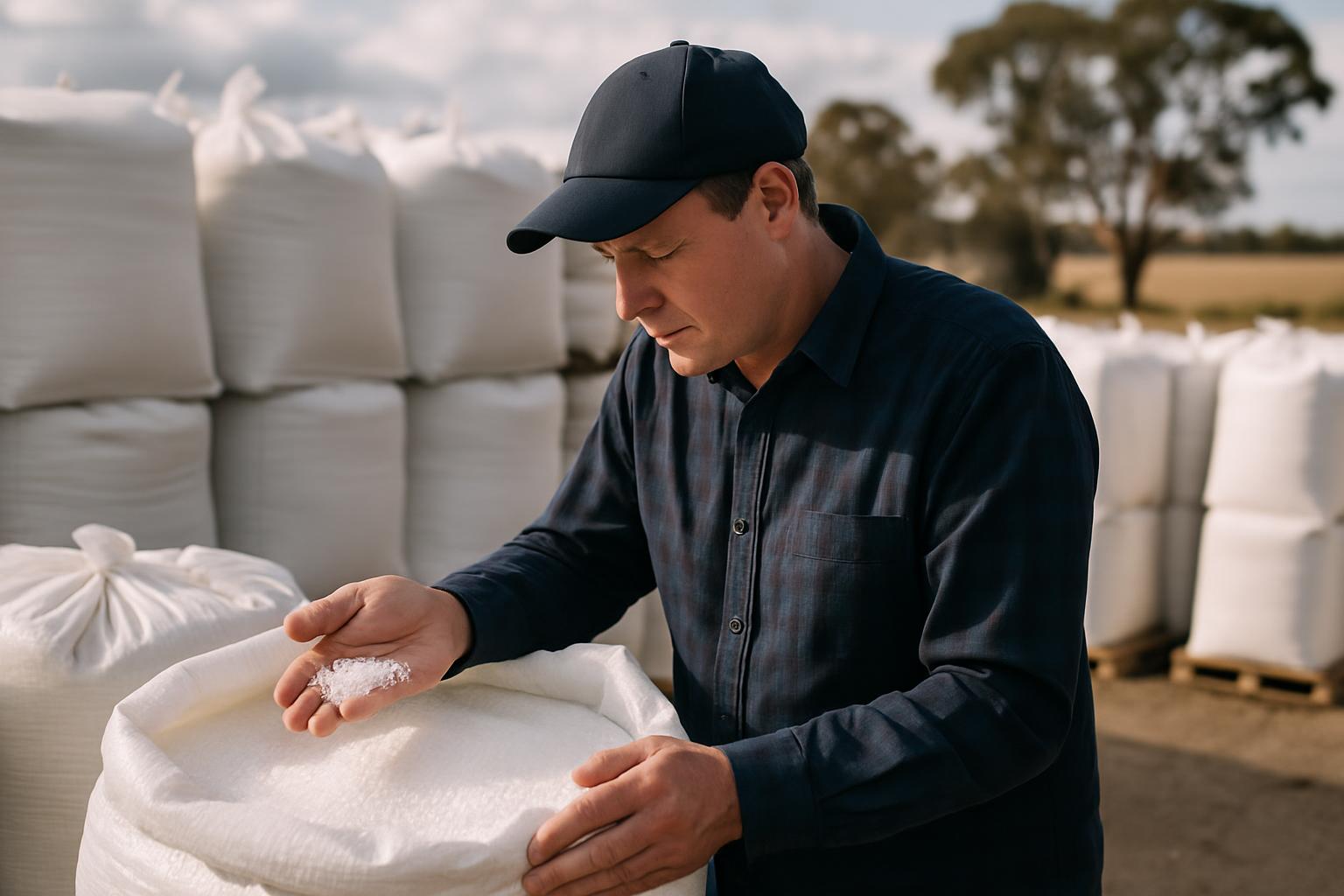
If you plan to buy urea in bulk Australia wide, the product is the easy part. Urea 46-0-0 is a standardised nitrogen fertiliser, so the real differences between offers come from load size, port of origin, packaging and what is actually written on the quote. This guide is for growers, resellers and agronomy businesses ordering 10 to 25 tonnes or more, and for export buyers sourcing from Australia. It explains typical truck and container loads, how ex-port pricing works, when bulk, bulka bags or small bags make sense, and the checks we recommend before you accept any offer. Rules, units and freight practice differ between countries, so we flag where they do.
In this article
- Key takeaways
- What bulk urea 46-0-0 is and who it suits
- Urea load sizes: from a 24 tonne semi to a container
- Port origins and what urea ex port really means
- Bulk, bulka bag or bagged urea: choosing a delivery format
- What to confirm on a bulk urea quote
- How much urea do you need? A worked example
- Receiving, storing and handling bulk urea safely
- Timing your order and buying from overseas
- Conclusion
Key takeaways
- Urea contains 46% nitrogen, so 1 kg of nitrogen needs about 2.17 kg of urea. Always plan rates in kg N per hectare first, then convert to product.
- A full semi-trailer load is commonly around 24 tonnes, a B-double is often 36 to 40 tonnes, and a 20-foot container of bagged urea is usually about 25 to 27 tonnes. Actual payloads depend on the operator, road rules and packaging.
- Most urea used in Australia is imported, so port of discharge and vessel origin affect lead time, availability and ex-port pricing.
- Bulk is usually cheapest per tonne, but bulka bags and bagged product can win on storage, handling and delivery access.
- A good written quote names the grade, specification, packaging, quantity tolerance, delivery terms, validity period and payment terms, not just a price per tonne.
What bulk urea 46-0-0 is and who it suits
Urea is an organic amide that carries the highest nitrogen concentration of any common solid fertiliser. At 46-0-0 it contains 46% N and no phosphorus or potassium. That density is the main reason it is traded in such large volumes: freight, storage and spreading costs per kilogram of nitrogen are lower than with most alternatives.
Granular urea versus prilled urea
Two physical forms are common. Prilled urea is made by dropping molten urea down a tower and cooling it into small, fairly uniform beads. Granular urea is built up in layers in a granulator and gives a harder, larger and more uniform particle, typically in the 2 to 4 mm range. For most broadacre buyers, granular urea bulk loads are preferred because the harder granule handles better, resists dust and breakage, and spreads more evenly over wide swaths. Prilled product is still widely sold and can suit smaller, lower-speed spreaders.
Specifications worth asking for
Ask for the nitrogen content (minimum 46% N is typical), moisture (commonly 0.5% maximum), biuret (commonly 1% maximum for soil application, much lower for foliar use) and size range. Biuret is a by-product that can harm seedlings and sensitive crops at higher levels. Request a certificate of analysis or typical specification for the actual parcel, not a generic sheet.
Where urea fits against other nitrogen sources
Urea is the default choice when the priority is cheap nitrogen. Where sulphur is also needed, ammonium sulphate may be a better fit, and our comparison of ammonium sulphate vs urea explains the trade-offs. Where you need nitrogen combined with phosphorus, potassium or trace elements in a single pass, compound or custom-blended products are worth pricing alongside straight urea.
Urea load sizes: from a 24 tonne semi to a container
Load size drives both the freight rate per tonne and how easily the product fits your farm or depot. The figures below are typical ranges rather than guarantees. Payload varies by trailer type, tare weight, state or regional road rules, axle limits and whether the delivery road suits larger combinations.
| Load type | Typical payload | Common format | Notes |
|---|---|---|---|
| Semi-trailer | About 24 to 26 t (53 to 57,000 lb) | Loose bulk or 1 t bulka bags | The most common single-delivery size for farms and small resellers |
| B-double | About 36 to 40 t (80 to 88,000 lb) | Loose bulk | Needs approved routes and suitable unloading access |
| Road train or larger | Varies by region | Loose bulk | Mainly remote and inland routes where permitted |
| 20 ft container | About 25 to 27 t | 25 to 50 kg bags or bulka bags | Common for exports and for rail or sea freight inside Australia |
The 24 tonne semi-trailer load
When buyers search for urea 24 tonne loads, they are usually describing a full semi-trailer. At a bulk density of roughly 0.74 to 0.77 t per cubic metre, 24 tonnes of urea occupies about 31 to 32 cubic metres. It is a practical unit: large enough to attract a good freight rate, small enough for most farm roads and storage sheds.
B-doubles and larger combinations
Higher-capacity trucks lower freight per tonne, but only if the site can receive them. Confirm turning room, gate width, tipping height and ground conditions. A truck that cannot get in is an expensive mistake, and the reroute or re-handling cost usually lands on the buyer.
Containers and part loads
Containers suit export orders and buyers who want bagged product on pallets. Part loads below a full truck usually cost more per tonne because freight is spread across fewer tonnes. If you can only take 10 to 15 tonnes, ask whether the load can share a truck or be combined with other products, such as DAP or potassium sulphate, on the same run.
Port origins and what urea ex port really means
Australia produces some nitrogen fertiliser domestically, but a large share of urea used in the country is imported. That means the commercial chain usually starts at a port, and the quote you receive reflects it.
Where Australian urea supply comes from
Import parcels have commonly come from the Middle East, South-East Asia, China and other producing regions, and the mix changes with seasons, export policies, gas prices and shipping conditions. Origin matters mainly for three reasons: the specification and granule quality can vary by producer, the voyage affects arrival timing, and some origins are more exposed to sudden export restrictions or logistics delays. Ask which origin your parcel is from, or whether the supplier is offering a spec rather than a named origin.
Reading an ex port price
Urea ex port generally means the price applies to product at the port or wharf store, before onward freight. Everything after that point is extra unless stated: loading onto trucks, haulage to your farm, any bagging or bulka filling, and delivery fees. Ex-port pricing is useful for comparing suppliers fairly, but it is not your landed cost. Our guide to what drives your fertiliser quote breaks down the components that move between a wharf price and the figure on your invoice.
Port-to-farm freight
Freight is often the largest variable after the product price. Distance from the nearest discharge port, backload availability, road access and fuel costs all affect it. A farm 150 km from a discharge port can have a lower landed cost than a nearer farm that is difficult to reach. Always ask which port the quote is based on, and request the delivered price as well as the ex-port price.
Bulk, bulka bag or bagged urea: choosing a delivery format
The right format depends on your storage, equipment and how quickly you will use the product. The pros and cons are summarised below, and our fuller guide on how to take delivery as bulk, bulka bag or bagged product goes deeper on each.
| Format | Best for | Advantages | Watch-outs |
|---|---|---|---|
| Loose bulk | Large farms and depots with covered storage | Lowest cost per tonne, fast unloading | Needs a dry shed, bunker or silo and loader access |
| Bulka bag (about 1 t) | Mid-size farms, split deliveries, remote sites | Flexible, stackable, protected from moisture | Needs a forklift or loader with lifting gear; bag cost added |
| 25 to 50 kg bags | Resellers, small blocks, horticulture, export | Easy to handle and resell; no machinery needed | Highest cost per tonne; more labour and packaging waste |
Loose bulk
Bulk is the cost leader for orders at or above a full truck. It requires a covered, dry floor or a suitable bin, and a plan to keep urea away from moisture, since it absorbs water readily from humid air.
Bulka bags
One-tonne bags let you take a truck load in manageable units and store product outdoors briefly on pallets under cover. They suit growers who spread over several weeks and do not want a whole load exposed in a shed. Confirm whether bags are single-trip, whether they have liners, and how many are on each pallet or truck.
25 to 50 kg bags
Small bags are the standard for resellers and export markets where hand handling is common. Check bag weight labelling, print language requirements and pallet wrapping, because import rules and customer expectations differ by country.
What to confirm on a bulk urea quote
A per-tonne price on its own is not a quote. The checklist below will help you compare offers on a like-for-like basis and avoid surprises on delivery day.
Product and quality
- Product name and grade: urea 46-0-0, granular or prilled, with size range.
- Specification limits for nitrogen, moisture and biuret, and whether a certificate of analysis comes with the parcel.
- Origin or port of discharge, if relevant to your requirements.
- Any coating or conditioning, such as anti-caking treatment.
Commercial terms
- Price per tonne, the currency, and whether GST or other taxes are included or added. Tax treatment differs between countries.
- Total quantity and tolerance, for example plus or minus 2 to 5%.
- Quote validity period, given how fast urea prices can move.
- Payment terms, deposits and any early-payment or late-payment conditions.
Delivery terms
- Delivery basis: ex port, ex store, delivered to farm, or FOB, CFR or CIF for export.
- Truck size and number of loads, plus delivery window and notice period.
- Unloading responsibilities, waiting time charges and site access requirements.
- What happens if product arrives damp, off-specification or short-weighted, including the claim window.
Natures Fertilizer Pty Ltd quotes each order individually in writing, so the points above can be confirmed against your tonnage, destination and packaging before you commit.
How much urea do you need? A worked example
Buying the right tonnage is as important as buying at the right price. Over-ordering ties up cash and storage; under-ordering means a second, smaller and more expensive delivery.
Converting nitrogen rates to urea
Agronomists set nitrogen in kg N per hectare. Divide by 0.46 to get kg of urea per hectare. For example, a 100 kg N/ha target requires about 217 kg urea/ha. In imperial terms, that is roughly 89 lb N per acre or about 194 lb of urea per acre.
Turning hectares into truck loads
Suppose you plan to cover 500 ha at 100 kg N/ha. The total is about 108.7 tonnes of urea, or between four and five 24 tonne loads. If you are buying 4 full loads and 1 part load, it may be more efficient to adjust the area, split the rate across two passes, or share a load with a neighbour. Always add an allowance for calibration error and spreader overlap, commonly a few percent.
Allowing for losses and timing
Surface-applied urea can lose nitrogen as ammonia gas when it is left on warm, moist soil without rain or incorporation. Timing applications ahead of rainfall, incorporating where possible, or considering other nitrogen sources can protect your investment. Our article on urea volatilisation explains how and why these losses happen. Rate decisions should always come from soil tests, yield targets and local agronomic advice, not from product convenience.
Receiving, storing and handling bulk urea safely
Good logistics extend beyond the purchase. A well-prepared site prevents quality loss and delays.
Before the truck arrives
Check the delivery slot, confirm contact details for the driver, and clear the unloading area. For bulk loads, make sure your shed or bunker is clean, dry and large enough. Inspect the product on arrival: look for lumps, wet patches, dust or foreign material, and take photos and a retained sample if anything looks wrong. Note any problems on the delivery docket before the driver leaves.
Storage conditions
Urea is hygroscopic, meaning it takes up moisture from humid air and can cake or clump. Store it under cover, on a clean, dry floor or pallets, away from rainfall and condensation. Keep it separate from other fertilisers to avoid contamination and mixing, and avoid storing it next to strong acids or bleach. Cover partly used piles tightly. In humid tropical regions, the storage window is shorter, so plan to use stock soon after delivery.
Handling and spreading
Use appropriate protective equipment, including gloves, eye protection and dust masks when handling loose product. Urea is not generally classified as a dangerous good for road transport in many jurisdictions, but local rules, shipping codes and workplace safety requirements vary, so check those that apply to you. Calibrate spreaders with the actual product, as granule size and density affect spread pattern and working width. Keep urea away from seed in the furrow, because it can damage germinating seedlings.
Timing your order and buying from overseas
Urea is a globally traded commodity, so its price and availability respond to events far beyond Australian farm gates: energy costs, crop prices, export policies and shipping rates all play a part.
Lead times and seasonal demand
Demand peaks ahead of winter-crop sowing and in-crop top-dressing, and again before pasture and summer-crop applications. Ordering early gives you a better chance of securing your preferred delivery window and format. Some buyers split purchases, locking in part of their requirement early and the rest nearer to use, which spreads price risk. Be wary of leaving all of your purchasing to the last week, particularly for large volumes or bagged and container formats that need preparation time.
Export buyers and shipping terms
Overseas buyers often need urea in containers with bagged product, palletised and labelled to destination rules. Typical terms are FOB (buyer arranges main freight), CFR or CIF (seller arranges freight to destination port) and payment by telegraphic transfer or letter of credit. Import permits, labelling, inspection and phytosanitary or fertiliser registration requirements differ by country, so confirm them with your local authority before ordering. Our guide on exporting fertiliser from Australia covers containers and payment terms in more detail. If you want nitrogen packaged with phosphorus, potassium or trace elements, Natures Fertilizer Pty Ltd also supplies compound NPK, blended and water-soluble products alongside urea 46-0-0, and can blend to a soil test.
Conclusion
To buy urea in bulk Australia wide with confidence, start with the nitrogen rate your soil test and crop plan call for, convert it to tonnes of urea, and match that tonnage to a sensible load size. Then compare offers on a delivered basis, noting port, format, specification and terms rather than headline price alone. Prepare your storage, inspect on arrival and plan timing around demand peaks. A clear written quote makes each of those steps easier.
Frequently asked questions
How much urea is in a standard truck load in Australia?
A full semi-trailer load is commonly around 24 to 26 tonnes, and a B-double can carry roughly 36 to 40 tonnes. Actual payloads depend on the trailer, road rules, packaging and access. Confirm the load size with your supplier before ordering.
What does urea ex port mean?
It means the price applies to product at the port or wharf store, before freight to your property. Loading, haulage, bagging and delivery fees are usually extra unless they are written into the quote. Ask for a delivered price as well so you can compare suppliers fairly.
Is granular urea better than prilled urea?
Granular urea is harder, larger and more uniform, so it handles and spreads better, especially with wide spreaders. Prilled urea is smaller and can be fine for lower-speed or smaller equipment. Both contain 46% nitrogen, so the choice is mainly about physical quality and spreading.
How do I convert nitrogen rates to urea?
Divide the kg of nitrogen per hectare by 0.46. For example, 100 kg N/ha needs about 217 kg of urea per hectare. In imperial units, that is roughly 89 lb N per acre or 194 lb of urea per acre.
Should I buy bulk urea or bulka bags?
Loose bulk is usually cheapest per tonne but needs dry covered storage and loader access. Bulka bags of about 1 tonne are more flexible, protect product from moisture and suit split use. Small bags of 25 to 50 kg cost more per tonne but need no machinery.
How should bulk urea be stored?
Keep it dry, covered and off wet ground, because urea absorbs moisture and can cake. Store it separately from other fertilisers and cover partly used piles tightly. In humid climates, plan to use the stock quickly after delivery.
Can I buy urea from Australia for export?
Yes, urea can be supplied for export in containers, usually as bagged product. Typical terms are FOB, CFR or CIF with payment by telegraphic transfer or letter of credit. Import requirements differ by country, so check them with your local authority first.
Leave a Reply