
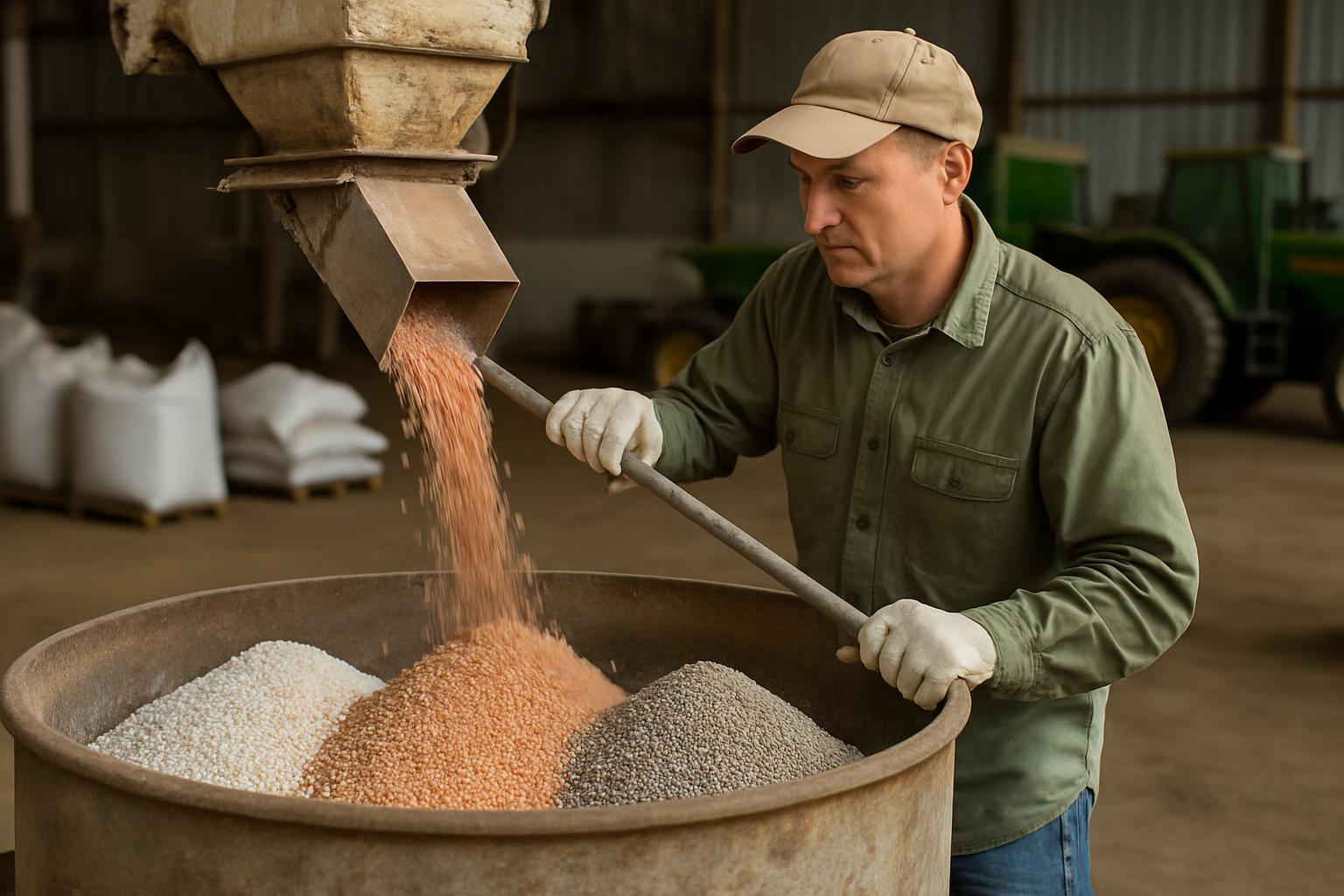
Custom fertiliser blending is the practice of mixing individual granular ingredients into one product built around a specific soil test, crop and yield target, instead of buying a fixed analysis off the shelf. Most explanations stop at that definition. This guide walks the whole process in order, from reading a soil test through to the tonnes on the truck, using one fully worked example with the arithmetic shown. You can follow the same method with your own numbers, or use it to check a quote you have been given. The example uses metric units with imperial equivalents, and it is an illustration of the method, not a recommendation for any particular paddock.
In this article
- Key takeaways
- What custom fertiliser blending actually involves
- Step 1: Start with the soil test and paddock history
- Step 2: Turn nutrient targets into kilograms per hectare
- Step 3: Choose ingredients and solve the blend maths
- Step 4: Convert the result into a recipe and an order quantity
- Quality control in a fertiliser blending service
- When a custom blend is not the right choice
- What to send when you request a custom blend quote
- Conclusion
Key takeaways
- A custom blend starts with a nutrient target in kg/ha, not with a product name. The recipe is solved backwards from that target.
- Phosphorus and potassium are usually fixed first because they come from fewer ingredients; nitrogen is then balanced with urea or another nitrogen source.
- Sulphur often arrives as a by-product of other ingredients such as sulphate of potash or ammonium sulphate, so count it before adding more.
- Granule size matching and handling matter as much as the recipe, because mismatched granules can separate during transport and spreading.
- Check that fertiliser labels and quotes use the same units. Phosphorus and potassium are quoted as P2O5 and K2O in many countries, but as elemental P and K in others.
What custom fertiliser blending actually involves
A blender holds several straight fertilisers in separate bins, weighs them to a recipe and mixes them into a uniform batch. The result is a physical mix of granules, each retaining its own composition. That is different from a compound granule, where every granule contains the same nutrient ratio.
How a blend is built from straight ingredients
Common building blocks include urea (46-0-0), DAP (18-46-0), MAP (11-52-0), sulphate of potash (SOP, about 0-0-50 plus roughly 18% sulphur), muriate of potash and ammonium sulphate (about 21% N and 24% S). Each ingredient supplies known nutrients, so the blender can hit a target analysis without paying for nutrients the soil does not need. Trace elements, such as zinc or boron, can be added as granular ingredients where the soil test supports it.
Blended versus compound products
Because blends are mixed from separate granules, the recipe can be changed from one paddock or season to the next. A compound product is made so each granule carries the same ratio, which suits some spreading situations. For a deeper comparison, see our guide to compound versus blended fertiliser, and our overview of high tower compound fertiliser.
Step 1: Start with the soil test and paddock history
No blend recipe is better than the information behind it. The soil test and the paddock history together decide which nutrients are worth paying for.
Reading the numbers that drive a blend
A useful soil test reports available phosphorus, available potassium, sulphur, pH and often a phosphorus buffering index or equivalent. Laboratories use different extraction methods, such as Colwell, Olsen, Bray or Mehlich-3, and the critical values differ by method, soil type and country. Always interpret results against local guidelines or with an agronomist. Our guide on how to read a soil test and choose a fertiliser covers this in more detail.
Setting a yield target and nutrient budget
Next, set a realistic yield target from rainfall or irrigation, past yields and crop. Crops remove nutrients in grain or biomass, and a sensible budget combines removal, soil supply and any build-up or maintenance strategy. Previous crops, residues, manure applications and pH all adjust the figures.
Step 2: Turn nutrient targets into kilograms per hectare
This is the step most summaries skip. Before choosing products, state the target as kilograms of each nutrient per hectare.
The example paddock
Imagine a 300 ha (about 740 acres) cereal block. The illustrative soil test shows moderate available phosphorus, low-to-marginal potassium, low sulphur and a slightly acidic pH. After working through the nutrient budget with an agronomist, the targets are:
- Nitrogen (N): 80 kg/ha
- Phosphorus (P): 18 kg/ha
- Potassium (K): 20 kg/ha
- Sulphur (S): 12 kg/ha
These figures are for demonstration only. Your own targets will differ with crop, soil and climate.
Converting between elemental and oxide units
Many labels in many countries show phosphorus as P2O5 and potassium as K2O. To convert, multiply elemental P by 2.29 to get P2O5, and elemental K by 1.205 to get K2O. In our example, 18 kg/ha of P equals about 41 kg/ha of P2O5, and 20 kg/ha of K equals about 24 kg/ha of K2O. Confirm which basis your agronomist or quote is using, because mixing the two is a common source of under- or over-application.
Step 3: Choose ingredients and solve the blend maths
Work through the nutrients in an order that lets each ingredient do as much as possible. A good rule is to fix the nutrients with the fewest sources first, then count what comes along for free.
Phosphorus first
We choose MAP, with about 22% elemental P and 11% N. To supply 18 kg P/ha we need 18 ÷ 0.22 = about 81.8 kg/ha of MAP. That also delivers 81.8 × 0.11 = about 9.0 kg N/ha. DAP could be used instead; our comparison of DAP and MAP explains the trade-offs.
Potassium and sulphur next
We choose sulphate of potash, with about 41% elemental K and 18% S. For 20 kg K/ha we need 20 ÷ 0.41 = about 48.8 kg/ha of SOP, which also supplies 48.8 × 0.18 = about 8.8 kg S/ha. The sulphur target is 12 kg/ha, so 3.2 kg S/ha is still missing. Ammonium sulphate at about 24% S fills the gap: 3.2 ÷ 0.24 = about 13.3 kg/ha, and it brings 13.3 × 0.21 = about 2.8 kg N/ha.
Balancing the nitrogen
Nitrogen supplied so far is 9.0 + 2.8 = 11.8 kg/ha. The remaining 80 − 11.8 = 68.2 kg N/ha comes from urea at 46% N: 68.2 ÷ 0.46 = about 148.3 kg/ha. The table summarises the result.
| Ingredient | Main nutrients | kg/ha | Share of blend |
|---|---|---|---|
| Urea | 46% N | 148.3 | 50.8% |
| MAP | 11% N, 22% P | 81.8 | 28.0% |
| Sulphate of potash | 41% K, 18% S | 48.8 | 16.7% |
| Ammonium sulphate | 21% N, 24% S | 13.3 | 4.5% |
| Total | N 80, P 18, K 20, S 12 | 292.2 | 100% |
Dividing nutrient totals by 292.2 kg gives an approximate blend analysis of 27.4% N, 6.2% P, 6.8% K and 4.1% S. In oxide terms that is roughly 27-14-8 plus 4% S. If you want more background on notation, read our article on reading an NPK ratio.
Step 4: Convert the result into a recipe and an order quantity
The per-hectare solution is now turned into something a blender can weigh and a buyer can order.
The per-tonne recipe
Scaling to 1,000 kg gives the recipe: about 508 kg urea, 280 kg MAP, 167 kg sulphate of potash and 45 kg ammonium sulphate. Rounding is normal, as long as the nutrient totals still match the target within an agreed tolerance. Blenders usually round to practical batch weights, so expect the final analysis to be close to, not identical to, the calculated figures.
Total tonnage and delivery
At about 292 kg/ha (roughly 260 lb/ac) across 300 ha, the order is 292.2 × 300 = 87,660 kg, or about 88 tonnes. Whether that is delivered in bulk, in bulka bags or in smaller bags depends on storage and spreading equipment; see how to take delivery. Real applications are often split, for example holding back part of the nitrogen for later top-dressing, so check crop-specific limits for how much nitrogen and potassium can safely be placed with the seed. These limits depend on crop, soil, seedbed and machinery.
Quality control in a fertiliser blending service
A good recipe can still fail in the paddock if the physical product is poor. Quality control is the other half of the process.
Granule size and segregation
If the ingredients differ greatly in granule size or density, they can separate while being moved, stored or spread, leaving some parts of the paddock with too much of one nutrient. Blenders reduce this risk by matching granule size ranges, often described by a size guide number, and by limiting handling. Ask which ingredients are used and whether the granule sizes are matched.
Analysis, tolerances and sampling
Ask how the final analysis will be confirmed and what tolerance applies. A representative sample drawn from the load, not just the top of a pile, is the fairest check. Keep samples from each delivery in case of questions later. Also note moisture, because hygroscopic ingredients can cake in humid storage.
When a custom blend is not the right choice
Blending is flexible, but it is not always the best fit. The comparison below summarises where each option tends to suit.
| Option | Best suited to | Main limitation |
|---|---|---|
| Custom blend | Paddocks with specific soil test gaps, bulk orders | Needs well-matched granules and careful handling |
| Compound granule | Uniform nutrient spread per granule, standard programs | Fixed ratio, less tailored |
| Water-soluble | Fertigation and foliar programs | Needs irrigation or spray equipment |
| Organic or biological | Soil biology and organic matter goals | Lower nutrient concentration per tonne |
Compound granules
If you spread with equipment that struggles with mixed granules, or want every granule to carry the same ratio, a compound product may be easier. Our page on NPK compound fertiliser suppliers explains this option.
Water-soluble and organic options
Drip or pivot irrigation systems often call for a water-soluble product rather than a granular blend. Organic and biological organic fertilisers can sit alongside a mineral blend to support organic matter. They are different tools, and an agronomist can help combine them.
What to send when you request a custom blend quote
Good inputs shorten the quoting process and reduce errors. Natures Fertilizer Pty Ltd blends to a customer’s soil test and quotes each order individually in writing, so the more complete your information, the faster the recipe can be checked.
Information checklist
- Soil test report, including the laboratory method used
- Crop, target yield and area in hectares or acres
- Target nutrient rates, or the agronomist’s recommendation
- Application method and timing, including any split applications
- Preferred delivery format, quantity and delivery location
For an overview of what to compare between suppliers, see our guide to ordering a custom blend to a soil test.
Notes for export buyers
Regulations, labelling and permitted ingredients differ between countries. Importers should confirm local registration requirements, preferred nutrient notation and packaging before ordering. Our article on exporting fertiliser from Australia covers containers and payment terms.
Conclusion
Custom fertiliser blending turns a soil test into a recipe in a few clear steps: set nutrient targets in kg/ha, choose ingredients, solve for phosphorus, potassium and sulphur, balance the nitrogen, then convert to a per-tonne recipe and an order quantity. The worked example shows how a 300 ha block with targets of 80 N, 18 P, 20 K and 12 S becomes roughly 88 tonnes of blend. Pairing a sound recipe with matched granules and a clear quality check gives the best chance that the product performs as planned.
Frequently asked questions
What is custom fertiliser blending?
It is the mixing of separate granular fertilisers, such as urea, MAP and sulphate of potash, into one product designed around a specific soil test and crop. The recipe is calculated from nutrient targets in kg/ha, so you pay only for the nutrients you need.
How do you calculate a fertiliser blend?
Set target rates for each nutrient, then divide each by the nutrient percentage of a chosen ingredient. Fix phosphorus and potassium first, count the sulphur and nitrogen they bring with them, and fill the remaining nitrogen with urea or another nitrogen source.
Is blended fertiliser the same as compound fertiliser?
No. A blend is a physical mix of different granules, while a compound fertiliser has the same nutrient ratio in every granule. Blends are more flexible, and compounds give a uniform spread per granule.
Can blended fertiliser separate during spreading?
It can if the granules differ greatly in size or density. Blenders reduce the risk by matching granule sizes and limiting handling, and buyers should ask how this is managed.
What information do I need to order a custom blend?
A soil test report, crop and target yield, area, application method and timing, and your delivery format and location. An agronomist’s recommended nutrient rates make the process faster and more accurate.
Why do some labels show P2O5 and K2O instead of P and K?
Many countries state phosphorus and potassium as oxides. To convert elemental P to P2O5 multiply by 2.29, and to convert elemental K to K2O multiply by 1.205. Always confirm which basis is used before comparing recommendations or quotes.
Can I put all my nitrogen in one blend?
It depends on crop, soil, rainfall and application method. Many growers split nitrogen between planting and top-dressing, and there are seed-safety limits when fertiliser is placed near the seed, so check local guidance first.
Leave a Reply